Anywhere from six to twelve months — the research found nothing arguing for delay. So I would rather use this page for something a Cavalier owner is far more likely to need: the signs that get mistaken for a behaviour problem when they are actually pain.
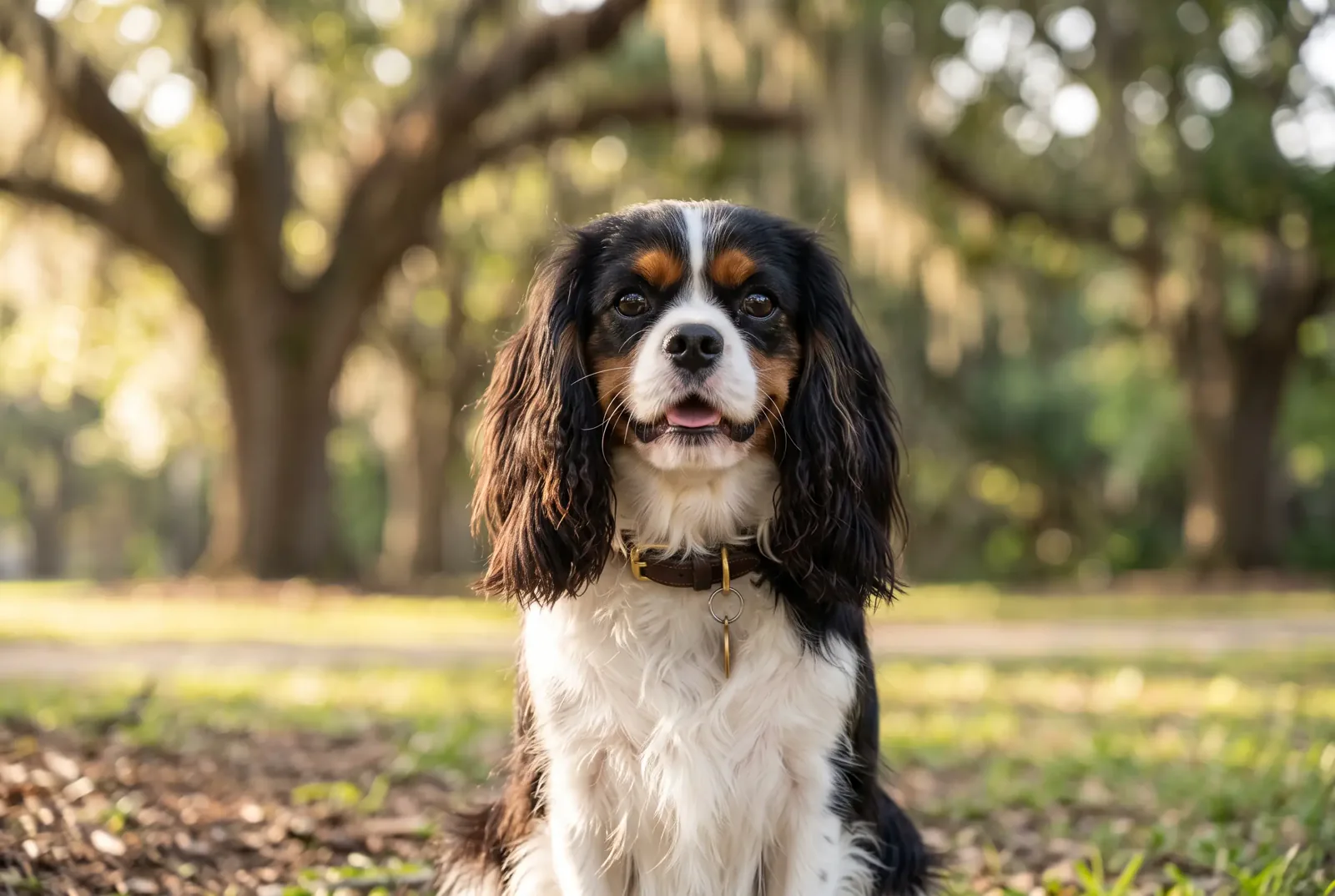
The timing question is easy here, so let me clear it. Across 286 Cavaliers the big neutering study found joint disorders in about 4% of intact males with no increase from neutering, cancers around 2% with no increase, and its guidance is simply that you should pick the age that suits you. Six to twelve months works for most households.
One thing before anything else, and it applies to him just as much as to a female: have his heart listened to properly before he is anaesthetised. Cavaliers are strongly predisposed to early mitral valve disease, and I set out why that matters on the female page. Read it.
With that said, here is what I would actually like this page to do. Owners of this breed are told, quite often, that a dog who yelps for no reason, hates his collar going on, or scratches at the air near his neck is being dramatic or difficult.
Sometimes he is in pain. And it is a specific, recognisable kind of pain that this breed gets and most others do not.
— Dr. P
The part worth reading
Cavaliers are predisposed to a structural problem in which the back of the skull is slightly too small for the brain behind it, which disturbs the normal flow of fluid around the spinal cord. In some dogs that leads to fluid-filled cavities forming within the cord itself — syringomyelia. What it produces is not a tidy, localised pain but abnormal nerve sensation, which is why it looks so strange from the outside.
Air scratching. A back leg comes up toward the neck or shoulder while he is walking, usually on one side, and never actually makes contact. People treat it as an itch, reach for ear drops or flea treatment, and get nowhere — because it is not an itch. It is the most recognisable sign there is, and in a Cavalier it should always prompt a proper look.
Sensitivity around the head and neck. Flinching or pulling away when touched there. Resenting a collar going on when he never used to. Ducking away from a hand coming toward his head, which is very easily read as him becoming nervous or badly behaved.
Yelping with no trigger. Crying out suddenly, often at night, or when jumping up or down, or when stretching. Owners frequently describe it as him being 'a bit sensitive' or 'dramatic'.
Odd sleeping postures, particularly holding the head higher than usual — on the arm of a sofa or a pile of bedding.
Because they come on gradually, and gradual changes get absorbed into a dog's personality. He becomes the dog who does not like his head touched, the dog who is funny about his collar, the dog who yelps sometimes. Nobody is being careless — it genuinely looks like temperament.
None of it has anything to do with neutering, and I am not suggesting the surgery causes or cures it. I am telling you because his neuter is very often the appointment where an owner mentions something odd in passing, and I would rather you knew which odd things are worth mentioning.
If any of this sounds like your dog, bring him in and say so plainly. It is diagnosed by imaging rather than by examination alone, it is manageable in most affected dogs, and the ones who do best are the ones whose owners raised it early rather than after two years of assuming he was just being difficult.
What I recommend
What neutering will not fix. Cavaliers are a genuinely affectionate breed and are prone to real distress when left alone. If what you want addressed is a dog who panics at the door closing, surgery is the wrong tool entirely, and I would much rather help you with the right one than take out his testicles and let you find out in three months that nothing changed.
And the one thing that changes the plan: an undescended testicle. If it has not come down by six months it is not going to, and a retained testicle carries a substantially higher risk of becoming cancerous while being impossible to check by feel. That gets its own timetable.
If you have a female Cavalier too, hers has a mammary-tumour clock running that he does not — that is on when to spay a Cavalier, along with the cardiac reasoning that applies to both of them.
What the day looks like
A neuter is the shorter and simpler of the two surgeries — the testicles are external, so it is one small incision just in front of the scrotum. That is also why there is no laparoscopic version worth offering, unlike a laparoscopic spay where the alternative is a long abdominal incision.
He skips breakfast that morning, has an IV catheter placed, plus pre-anaesthetic bloodwork if you've chosen it (I recommend it, and it's priced separately), and is monitored continuously while he is under, with particular attention to his cardiovascular monitoring in this breed. I will have listened to his chest carefully before we start. I do the surgery myself; I have been a solo veterinarian since 1998. He goes home the same day with pain medication. More on the day itself is on what to expect from your pet's surgery.
Cavalier neuter questions
That specific behaviour has a name — people call it air scratching — and in a Cavalier it should always prompt a proper look rather than a bottle of ear drops. A back leg comes up toward the neck or shoulder while he is walking, often on one side, and never quite touches. It is one of the more recognisable signs of syringomyelia, a condition where fluid-filled cavities develop within the spinal cord, usually because the back of the skull is slightly too small for the brain behind it. The sensation it produces is not really an itch — it is abnormal nerve signalling — which is exactly why scratching does not satisfy it and why treating it as a skin problem gets nowhere.
Sensitivity around the head, neck and ears — flinching or pulling away when touched there, or resenting a collar going on when he never used to. Yelping or crying out with no obvious trigger, often at night or when jumping up or down. Sleeping in odd positions, particularly with the head held higher than usual. Sometimes weakness or scuffing in a front leg. It tends to come on gradually, which is why it so often gets filed under 'he's got funny in his old age' rather than investigated.
Nothing at all, and I want to be plain about that so you are not weighing the two together. This is a structural problem of the skull and spinal cord — it has no hormonal component, and the timing of his neuter neither causes it, prevents it, nor affects how it progresses. The reason it is on this page is simpler than that: his neuter is very often the appointment where an owner first mentions something odd he has been doing, and I would rather you knew which odd things are worth mentioning.
Six to twelve months suits most families and there is no penalty either side. The study found joint disorders in about 4% of intact Cavalier males with no increase from neutering, cancers at about 2% with no increase, and its guidance is simply to pick the age that suits you. What tends to decide it in practice is whether he has started marking indoors and whether there is an intact female in the house. There is one thing I would ask you to do first, though, and it is on the female page: have his heart properly listened to.
Because Cavaliers are strongly predisposed to degenerative mitral valve disease, and unlike most breeds it commonly appears in middle age or earlier rather than in old age. A neuter is a short procedure, but it is still an anaesthetic, and an anaesthetic in a dog with a healthy heart is a different proposition from one in a dog with a leaking valve and an enlarged heart. At six to twelve months I usually expect to hear nothing — and that is both the ideal time to operate and a useful baseline for the rest of his life. I go through this properly on the female page; every word of it applies to him.
Less than you would hope, and in this breed less than in most, because Cavaliers are not usually difficult in the ways testosterone drives. Neutering reduces roaming, urine marking, persistent mounting and some male-to-male tension. It does nothing for separation anxiety, which this breed is genuinely prone to, and nothing for a dog who is simply very attached to you. If what you are describing is distress when left alone rather than hormonal behaviour, surgery is the wrong tool and I would much rather help you with the right one.
Keep reading
Every breed grows on its own schedule. If one of these is closer to your dog, start there.
Your Cavalier King Charles Spaniel, the other half of the question:
Similar-size breeds:
The whole picture: read the veterinarian's breed-by-breed spay and neuter guide, or see how the laparoscopic spay works.
The date takes a minute. If he does anything on this page that you'd written off as him being dramatic, that's the part I'd like to hear about.
Request an Appointment Or text (281) 859-9244