Anywhere from six to twelve months — the male findings in this breed are about as clean as any in the research, so the date is genuinely yours. What is worth ten minutes of your attention is his breathing, and specifically whether you have been normalising it.
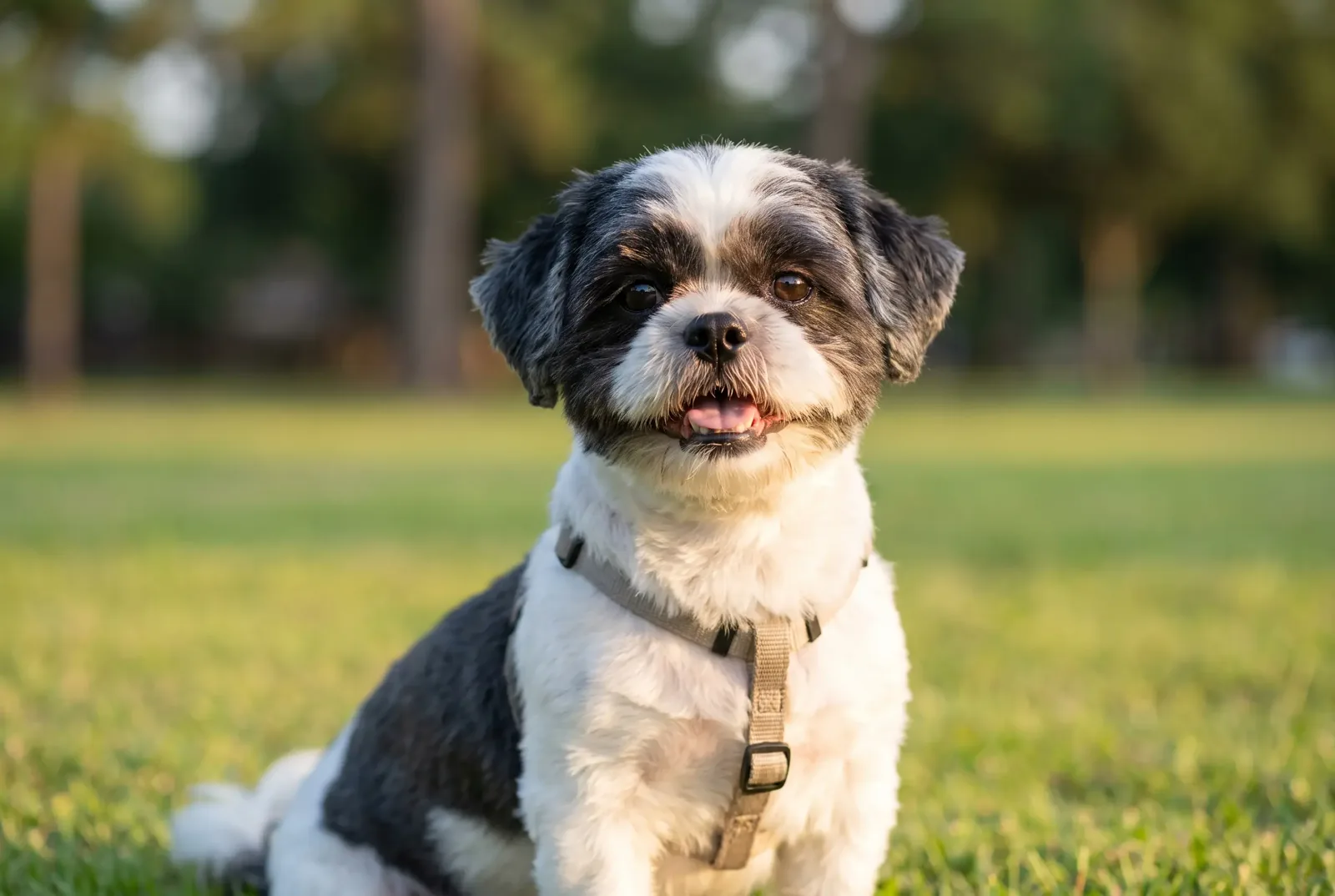
The timing answer here is short and I will not pad it. Among Shih Tzu males the study found no joint disorders at all in any group, and 0% cancers in intact males with nothing noteworthy in neutered ones. Its guidance is to pick whatever age suits you, and I agree — six to twelve months works for most households.
So let me use the space for the thing I would actually check before booking him in.
A Shih Tzu is a brachycephalic dog — shortened muzzle, compressed airway — but a mild one, and that mildness is its own trap. Owners read that brachycephalic problems are a bulldog issue, look at their comparatively normal-seeming dog, and conclude it does not apply.
Meanwhile years of snoring, snorting and stopping to catch his breath get filed under "that's just how he sounds". Sometimes that is true. Sometimes it is a dog working harder to breathe than he should be, and nobody has ever said so out loud.
— Dr. P
Worth ten minutes before you book
Brachycephalic is not a yes-or-no category, it is a range. At one end are dogs whose airways are obviously compromised and whose owners already know it. At the other are dogs with a slightly shortened face and no functional problem at all. Most Shih Tzus sit somewhere in between, and where yours falls is genuinely useful to establish before an elective anaesthetic rather than during one.
Watch and listen when he is not thinking about it:
Research on brachycephalic dogs as a group — not Shih Tzus specifically — has found meaningfully higher rates of complications around anaesthesia than in dogs with normal-length muzzles. That is a reason for planning, not for avoiding the surgery.
In practice it means a smooth induction, secure airway control while he is under, and particular attention as he wakes up. Recovery is when a compromised airway causes trouble, so brachycephalic patients stay under closer observation while they come round rather than going straight to a quiet kennel.
If several of those signs describe him, that is worth a conversation in its own right and not only in the context of a neuter. Sometimes there is something straightforward to be done about it. Either way, I would rather know before the day than discover it on the table.
What I recommend
What neutering will and will not do. It reduces roaming to find a female, urine marking, persistent mounting and some male-to-male tension — and marking responds best if you act while the habit is new rather than after a year of it. It will not make him quieter, less demanding of attention or less opinionated about strangers at the door. Those are temperament, not hormones.
The one thing that changes the plan: a testicle that has not descended by six months. Undescended testicles are disproportionately common in small breeds, they carry a substantially higher risk of becoming cancerous, and they cannot be monitored by feel. That gets scheduled on its own timetable.
If you also have a female Shih Tzu, her decision is markedly harder than his — the research points one way and I go the other, and I have set out exactly why on when to spay a Shih Tzu. Worth reading properly.
What the day looks like
A neuter is the shorter and simpler of the two surgeries — the testicles are external, so it is one small incision just in front of the scrotum. That is also why there is no laparoscopic version worth offering, unlike a laparoscopic spay where the alternative is a long abdominal incision.
He skips breakfast that morning, has an IV catheter placed, plus pre-anaesthetic bloodwork if you've chosen it (I recommend it, and it's priced separately), and is monitored continuously on a warming system. Because of his muzzle he stays under closer observation as he wakes up than a longer-nosed dog would. I do the surgery myself; I have been a solo veterinarian since 1998. He goes home the same day with pain medication, and while he is asleep I will check his mouth — crowding and retained baby teeth are the norm in this breed, and dealing with them now saves a second anaesthetic later. More on the day itself is on what to expect from your pet's surgery.
Shih Tzu neuter questions
Yes, though he sits at the milder end of that spectrum, and that is exactly why it is worth raising. A French Bulldog's airway problem is obvious enough that everybody plans around it. A Shih Tzu's often is not — he has a shortened muzzle and the same compressed anatomy, just usually less extreme. The risk is that his owner has read that brachycephalic issues are a bulldog problem, concluded it does not apply, and normalised years of snoring and snorting as just how he sounds. Some Shih Tzus genuinely are fine. Others are managing a narrowed airway quietly, and the difference matters before an anaesthetic.
Watch and listen when he is not thinking about it. Does he snore loudly when asleep, or make snorting or honking sounds when excited? Does he breathe noisily on a normal walk, or need to stop and recover after modest exercise that other dogs of his size take in their stride? Does he struggle noticeably in the heat, or sleep with his head propped up or in odd positions to keep his airway open? Any of those suggests he is working harder to breathe than he should be. Bring him in and I will look at his nostrils and listen to him properly — that is a five-minute assessment and it changes how I plan his day.
It means it is planned rather than assumed, which is a different thing. Research on brachycephalic dogs as a group — not Shih Tzus specifically — has found meaningfully higher rates of complications around anaesthesia than in non-brachycephalic dogs. What that translates to in practice is care at particular moments: a smooth induction, secure control of his airway while he is under, and above all attentive supervision as he wakes up, because recovery is when a compromised airway is most likely to cause trouble. I keep brachycephalic patients under closer observation while they come round rather than sending them straight to a quiet kennel.
Six to twelve months suits most families and there is genuinely no penalty on either side. The male findings in this breed are as clean as any in the whole study — no joint disorders at all in any group, and 0% cancers in intact males with nothing noteworthy appearing in neutered ones. The paper's guidance for males is simply to pick the age that suits you. What tends to decide it in practice is whether he has started marking indoors and whether there is an intact female in the house.
Not for him. That finding is in females, at the one-year spay band, and it does not appear on the male side at all — intact and neutered males alike recorded essentially nothing. It is, however, a genuinely difficult question for anyone with a female Shih Tzu, and I have written a whole page about why I disagree with the guideline that came out of it. If you have a female as well, read it, because that decision is much harder than this one.
His mouth, which in this breed usually needs it. A Shih Tzu carries a full set of teeth in a very short jaw, so crowding is the norm, teeth are often rotated or misaligned, and retained baby teeth are common — where an adult tooth comes in beside a deciduous one that should have gone, food packs into the gap and dental disease starts young. Dealing with any of that while he is already asleep saves him a second anaesthetic, which in a brachycephalic dog is a saving worth having. I will always speak to you before doing anything beyond what we agreed.
Keep reading
Every breed grows on its own schedule. If one of these is closer to your dog, start there.
Your Shih Tzu, the other half of the question:
Similar-size breeds:
The whole picture: read the veterinarian's breed-by-breed spay and neuter guide, or see how the laparoscopic spay works.
The timing takes a minute. Working out where he sits on the brachycephalic spectrum is the part worth doing before surgery day rather than on it.
Request an Appointment Or text (281) 859-9244