If he is behaving well, wait until eighteen to twenty-four months — longer than I ask of most large breeds. If hormonal behaviour problems appear before then, particularly marking or roaming, that is a good reason to move sooner.
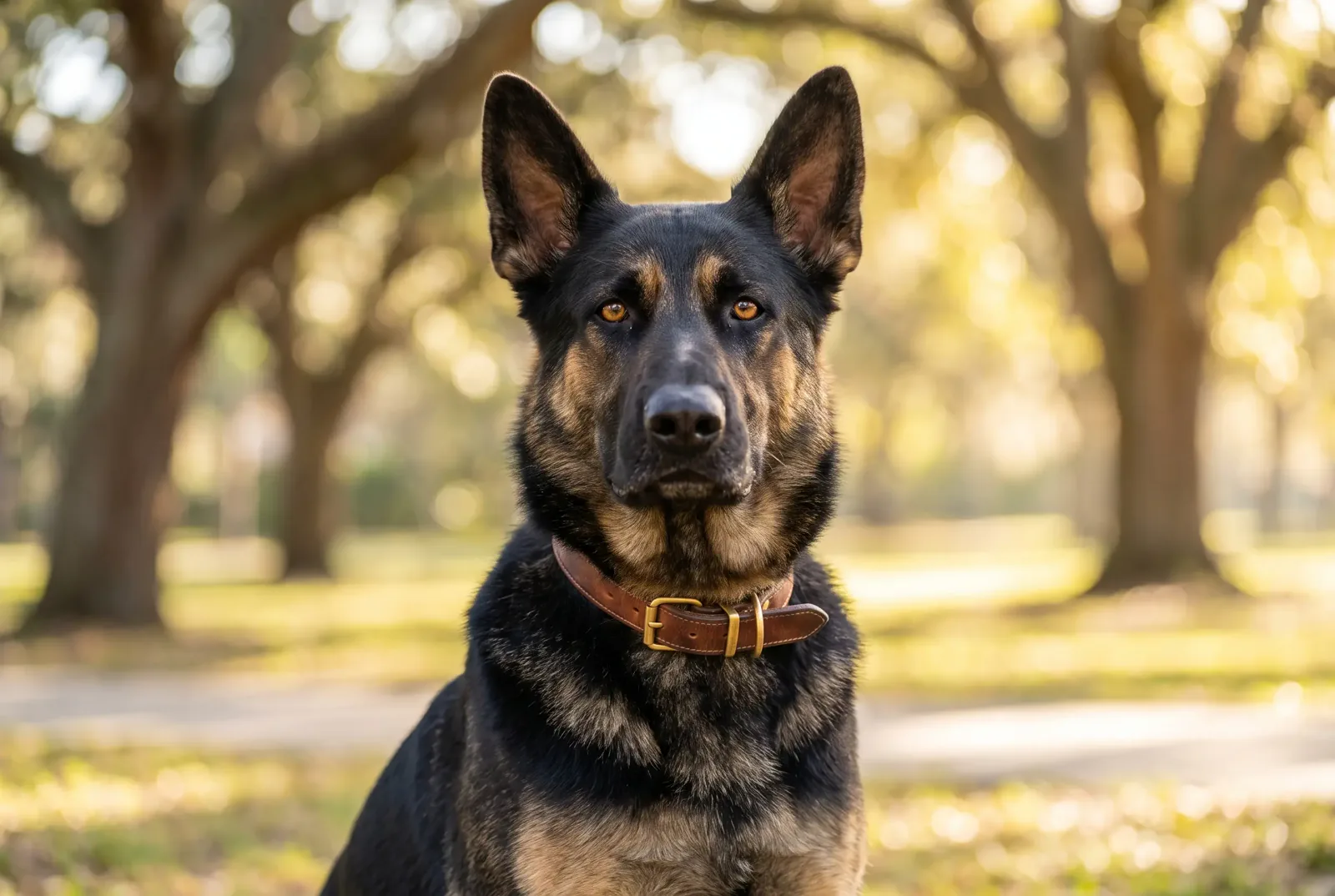
Most families who bring me a young male German Shepherd to discuss neutering are not really asking about joints. They are asking about behaviour — and often they have been told, by someone they trust, that neutering will take the edge off him.
So let me deal with that first, because it is the part that most affects what you decide.
Neutering will not make a German Shepherd less protective, less reactive on lead, less suspicious of strangers, or less inclined to bark at the door.
Those behaviours are temperament and learning. They are what the breed was built for. Testosterone drives a much narrower list — roaming, marking, mounting, and some male-to-male tension — and that is the list neutering actually addresses.
I say this because I have watched families neuter a nine-month-old Shepherd expecting a calmer dog, get the same dog back, and feel let down twice over: the behaviour did not change, and they gave up the joint benefit of waiting. That is a bad trade, and it is avoidable.
What the research actually shows
The German Shepherd is one of the 35 breeds in the large UC Davis neutering study, and it also has a dedicated paper of its own from the same group. Very few breeds have both, so this guidance rests on breed-specific evidence rather than on reasoning across from other big dogs.
For males, about six percent of intact German Shepherds developed one or more joint disorders — hip dysplasia, elbow dysplasia, or cruciate ligament rupture. Neutered before six months, that rose to nineteen percent. Between six and eleven months, eighteen percent. The breed's own dedicated study found much the same shape: roughly seven percent in intact males against twenty-one percent in those neutered before a year.
That middle figure is the one that sets this breed apart, and it is worth slowing down on. In most breeds, by the time you reach the one-to-two-year band the increased joint risk has flattened out — waiting a year is enough. In the German Shepherd it had not. Males neutered in that window were still running about nine percent against six percent in intact dogs, and that difference was statistically significant.
That single finding is why the researchers set their guideline for this breed at over two years rather than at one, and it is the reason I ask German Shepherd families for more patience than I ask of Labrador or Boxer families.
The cancer news is genuinely reassuring by contrast. Unlike the Golden Retriever, where early neutering was linked to a real rise in several cancers, the German Shepherd showed no appreciable increase in the cancers followed at any neuter age. This is an orthopaedic conversation, not a cancer one.
One honest caveat: these are percentages drawn from a hospital population, and the study's per-breed sample sizes are published separately from the main text. They tell you the direction and rough size of the risk, not your dog's personal odds.
The thing that actually moves the date
Because behaviour is what shortens the timeline, it is worth being precise about which behaviours are genuinely hormonal.
Testosterone genuinely drives these: roaming or escaping to find a female, urine marking indoors, persistent mounting, and some male-to-male posturing. When these appear in an intact adolescent, neutering helps — and helping sooner improves the odds, because a behaviour caught early has not yet become a practised habit.
Testosterone does not drive these: guarding the house, barking at the door, lunging at dogs on lead, wariness of strangers, resource guarding, or noise anxiety. In a German Shepherd these are the breed doing what the breed does, shaped by how it has been raised and trained. Surgery does not touch them.
There is one more honest note. In some dogs, neutering appears to slightly increase fearfulness or noise sensitivity, particularly when done very young in an already-anxious animal. It is not common and it is not a reason to skip the surgery. But if your Shepherd is already a nervous one, it is a further argument for letting him mature first rather than operating at six months.
What I recommend
Where this comes from. The study's own guideline for this breed is to delay past two years. My usual large-breed recommendation is twelve to eighteen months. I land at eighteen to twenty-four because I think this breed's evidence justifies going beyond my normal window, while a hard two-year rule asks more of most families than the marginal difference buys. That reconciliation is my clinical judgement, not a study finding, and you should know which is which.
And the override. If he starts marking in the house, escaping the yard, or mounting persistently, bring him in and we will talk about going sooner. If he has a retained testicle that has not descended, we should not wait at all — undescended testicles carry a substantially higher cancer risk and need to come out. And if he was neutered young, before you knew any of this, he is not doomed; most early-neutered Shepherds live long, sound lives.
No honest veterinarian can hand you a date without meeting your dog. What I can offer is a real conversation about his growth and how he is actually behaving at home.
What the day looks like
A neuter is a shorter and simpler surgery than a spay. The testicles are external rather than deep in the abdomen, so it is one small incision just in front of the scrotum and a fraction of the time an abdominal procedure takes. That is also why there is no laparoscopic version to offer — nothing here for a camera to improve on, unlike a laparoscopic spay, where the alternative is a long abdominal incision.
He skips breakfast that morning, has an IV catheter placed, plus pre-anaesthetic bloodwork if you've chosen it (I recommend it, and it's priced separately), and is monitored throughout. I do the surgery myself. He goes home the same day with pain medication, and most dogs are bright by the next morning — which is the hard part, because a Shepherd who feels fine on day two still needs about a week of no running or jumping. Some swelling for a few days is normal. More on the day itself is on what to expect from your pet's surgery.
German Shepherd neuter questions
Almost certainly not, and I would rather say that plainly than let you find out afterward. German Shepherd guarding, territorial barking, leash reactivity and suspicion of strangers are temperament and learning, not testosterone. Neutering reliably reduces roaming, urine marking, mounting and some male-to-male tension — that is the honest list. If your concern is how he handles visitors or other dogs on lead, the answer is a behaviour plan and a trainer who knows the breed, not surgery.
Not medically, no. He is not at risk of pyometra the way a female is, and there is no equivalent of the mammary-cancer clock on the male side. Testicular cancer exists but is uncommon and usually treatable. What you are managing while you wait is practical rather than medical: keeping him away from intact females, and staying on top of any hormonal behaviours if they appear.
That moves my recommendation, yes. Marking is one of the behaviours genuinely driven by testosterone, and neutering resolves it in a good proportion of dogs — especially if you act while the habit is new rather than after a year of practice. I would rather neuter a fourteen-month-old German Shepherd and keep him living successfully in your home than protect a growth plate while the household relationship deteriorates.
That is what makes German Shepherds unusual. In most breeds the increased joint risk has faded by the time you reach the one-to-two-year band. In this breed it was still statistically elevated there — around nine percent against six percent in intact males. That single finding is why the researchers set their guideline past two years rather than at one, and it is why I ask German Shepherd families for more patience than I ask of most.
Yes, and most owners consider it a benefit. Testosterone contributes to the heavier head, thicker neck and more substantial bone that people associate with a mature male German Shepherd. A dog neutered at six months often finishes leggier and lighter-framed. That is cosmetic rather than medical, but since waiting is what I am recommending on health grounds anyway, it is a fair thing to mention.
Not at all, and there is nothing to correct. At three he has long since finished growing, so none of the joint concerns in the research apply to him — those are about neutering very early. If you want him neutered now for practical reasons, it is a straightforward surgery and he will recover well. If he is doing fine as he is, there is no medical urgency either.
Keep reading
Every breed grows on its own schedule. If one of these is closer to your dog, start there.
Your German Shepherd, the other half of the question:
Similar-size breeds:
The whole picture: read the veterinarian's breed-by-breed spay and neuter guide, or see how the laparoscopic spay works.
Bring him in and we'll look at his growth and how he's actually behaving at home, then pick a window that fits your dog and your household.
Request an Appointment Or text (281) 859-9244