Somewhere between twelve and eighteen months for most Husky males, though the research is more relaxed than I am and I will show you where we differ. This is also the one breed where I think behaviour can genuinely outrank the calendar — because the behaviour in question is the one most likely to get him killed.
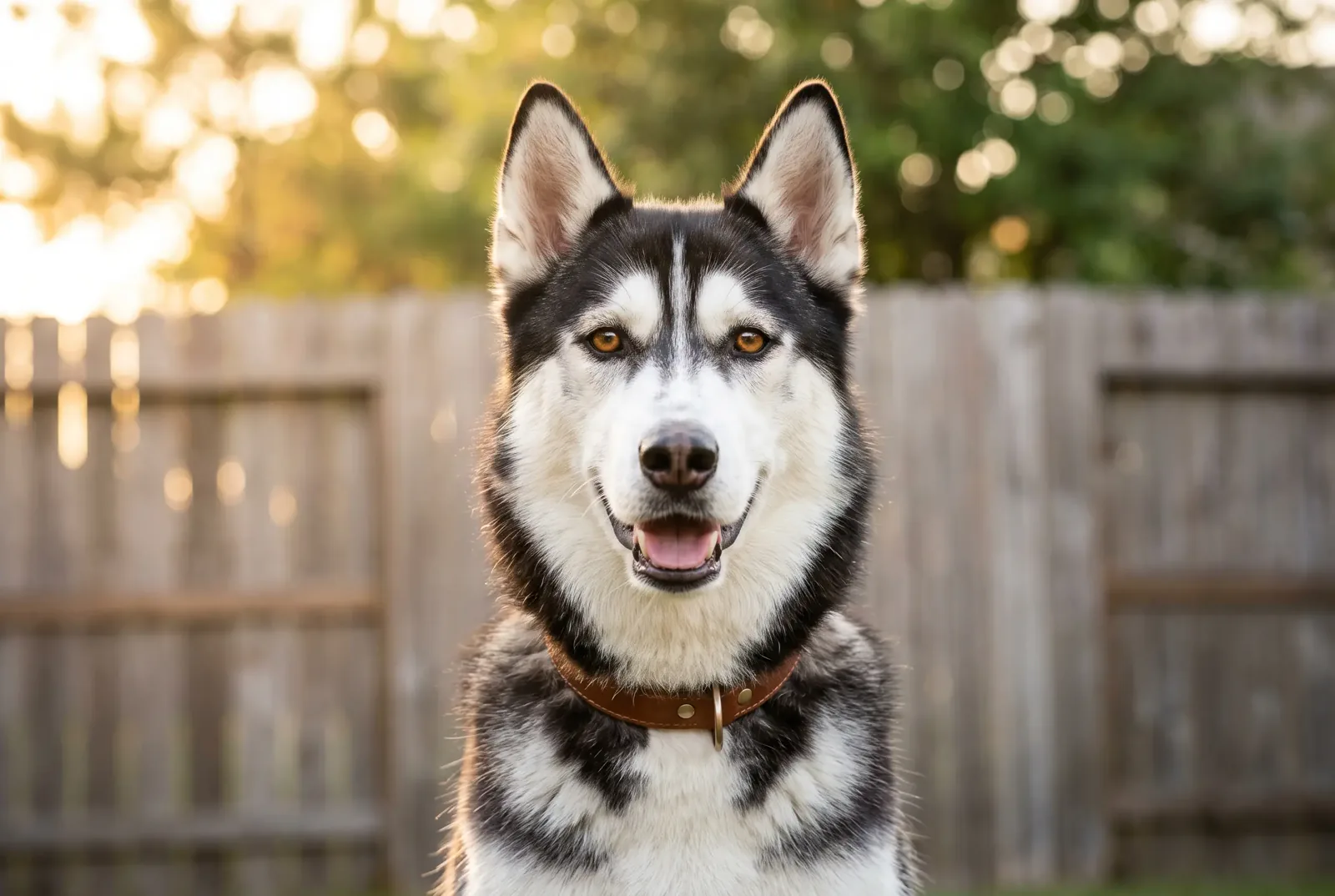
On nearly every male page in this series I make the same argument: waiting costs a male dog essentially nothing, so let him finish growing, and treat behaviour as a reason to move sooner only if it is genuinely making him hard to live with.
The Husky is where I put more weight on the behaviour half than I do anywhere else, and it is worth explaining why.
The single most reliably testosterone-driven behaviour in a male dog is roaming to find a female. It is also the behaviour that neutering most dependably reduces.
And in this breed, roaming is not a nuisance. It is the thing that kills them. A Husky who gets out does not potter around the block — he covers ground, fast, in a direction of his own choosing. In Cypress that means traffic, and in July it means heat as well.
— Dr. P
So the research half of this page is short and mostly good news. The half I care about is what you do with an intact adolescent Husky in a Texas summer.
What the research actually shows
Worth knowing if you have searched this before: the well-known breed-by-breed neutering study covers thirty-five breeds and the Siberian Husky was not among them, which is why older articles all end with a shrug about reasoning from size. In 2024 the same research group published a follow-up adding five more breeds, and the Husky was one. If an article tells you no Husky data exists, it predates that paper.
For males the findings are about as quiet as they come. Among 64 intact and 77 neutered males, joint disorders affected about 2% of intact dogs with no significant elevation at any neuter age. Cancers affected about 10% of intact males, again with no significant elevation at any age. The study's guideline for males is simply to neuter no earlier than six months.
Where I differ from the paper, and why. The study asks only that you not do it before six months. I suggest twelve to eighteen. That gap is mine, not the study's, and I would rather label it than let it pass as evidence. My reasoning is unglamorous: his growth plates finish closing around a year, the mechanism people worry about — hormones withdrawn before those plates close, long bones growing slightly longer, joint angles shifting — does not care that this particular breed's numbers came back quiet, and waiting costs him nothing at all. Given a free option and a plausible mechanism, I take the option. You are entitled to weigh that differently, and if you have a reason to do it at eight months I will not fight you.
I make the same disclosure on the Labrador page, for the same reason. On the female side of this breed it runs the other way — there the study is the cautious one, and I simply agree with it. That is on when to spay a Husky.
The part that actually moves the date
Let me be precise about what neutering does and does not fix, because the honest list is short.
It genuinely helps with: roaming and escaping to find a female in season, urine marking, persistent mounting, and some forms of male-to-male tension. These are testosterone-driven and they respond.
It does nothing for: energy level, vocalising, digging, escape attempts motivated by boredom rather than hormones, stubbornness about recall, or the breed's settled belief that your fence is a suggestion. Those are Husky. A neutered Husky is still a Husky.
That second list is why I will not tell you neutering solves your containment problem. What it does is remove one strong motivation from a dog who already has several — and in a breed where getting out is genuinely dangerous, removing one of them is worth having.
A loose Husky is not a dog wandering two streets over. He is a dog covering distance at speed, and the distance he covers takes him to roads he does not understand. Add a Texas summer and you have a double-coated arctic breed running hard in ninety-five-degree heat.
So if he has started escaping to find females, I will bring the surgery forward without much argument. Protecting a growth plate is a marginal gain. Not losing him is not.
The rest of the containment problem stays yours, and it is worth doing properly: a fence he cannot go over, under or through, a genuinely tired dog rather than a bored one, and identification that works — a microchip with your current phone number on it, which I can check and update at any visit.
Living here, specifically
This is not really a neutering question, but I see the consequences often enough that I am not going to write a Husky page without it. His double coat is genuinely good insulation and it works in both directions, slowing heat gain as well as heat loss — but he still cools himself mostly by panting, and a July afternoon here gives him very little to work with.
The practical version is short. Exercise him early in the morning or after dark, not in the middle of the day. Shade and water available whenever he is outside, without exception. Do not shave the coat: it removes insulation that is working in his favour and it can grow back poorly. And check the pavement with your hand before walking him on it, because tarmac that is uncomfortable for five seconds on your palm will burn his pads.
Know what overheating looks like, because it moves quickly: frantic panting that will not settle, bright red gums, heavy drooling, staggering, vomiting or collapse. That is an emergency — get him cool with room-temperature water, not ice, and get him seen immediately. Around his surgery this matters practically too, since he will be recovering during the hottest part of the year if we operate in summer, and his exercise restriction and the heat restriction will overlap.
What I recommend
Where I deviate, and this is the breed where I mean it most. If he is escaping to find females, bring him in and we will do it sooner. I will not ask you to hold out for a skeletal benefit that is marginal in a breed whose numbers came back this clean, while a dog who covers five miles in the wrong direction is loose in Cypress traffic. If a testicle has not descended by six months, that changes the plan entirely and it should come out on its own timetable. And if he is a working or sport dog — a proper canicross or sledding dog rather than a pet — I lean to the later end of the window.
No honest veterinarian can hand you an exact date without meeting your dog. Bring him in and we will look at how he is growing, how he is behaving, and how secure your yard actually is, and settle it together.
What the day looks like
A neuter is the shorter and simpler of the two surgeries. The testicles are external rather than deep in the abdomen, so it is one small incision just in front of the scrotum and a fraction of the time an abdominal operation takes. That is also why I do not offer a laparoscopic version — there is nothing here for a camera to improve on, unlike a laparoscopic spay, where the alternative is a long abdominal incision.
He skips breakfast that morning, has an IV catheter placed, plus pre-anaesthetic bloodwork if you've chosen it (I recommend it, and it's priced separately), and is monitored continuously while he is under. I do the surgery myself — I have been a solo veterinarian since 1998, so the person who examined him and the person holding the instruments are the same person. He goes home the same day with pain medication, and most are bright by the next morning, which is precisely the problem with this breed: a Husky who feels fine still needs about a week without running or jumping, and he will have opinions about that. It is worth having a plan for the week before the day arrives. More on it is on what to expect from your pet's surgery.
Husky neuter questions
It will help with one of the two reasons he escapes, and not at all with the other. Roaming to find a female in season is genuinely hormonal, and neutering reduces it substantially — that is one of the most reliable behavioural effects of the surgery. But a great many Huskies escape for reasons that have nothing to do with hormones: boredom, under-exercise, and a breed-level enthusiasm for seeing what is over there. Neutering does nothing for that. So it is worth doing if roaming is part of his picture, and it is not a substitute for a properly secured yard and a genuinely tired dog.
Because I am taking a free option, and I would rather show you that than pretend my number came out of the paper. The research on male Huskies found no significant increase in joint disorders or cancers at any neuter age — it is one of the cleaner male results in the whole literature — and its guideline is simply not to do it before six months. My twelve-to-eighteen months is me reasoning that his growth plates close around a year, that waiting costs a male dog essentially nothing, and that I would rather have him fully built. That is a preference informed by the data rather than a finding from it, and if you have a good reason to do it at eight months I will not argue with you.
It is, and it is worth planning around rather than worrying about. A Husky's double coat is superb insulation, which works in both directions — it slows heat gain as well as heat loss — but he still cools himself mainly by panting, and a Cypress afternoon in July gives him very little to work with. The practical consequences are simple: exercise early morning and after dark rather than the middle of the day, always have shade and water available, and never leave him shut outside in summer without both. Do not shave the coat, which removes the insulation that is helping him. And know what overheating looks like: frantic panting that will not settle, bright red gums, drooling, staggering or vomiting is an emergency.
Not in the way you are hoping. Neutering addresses roaming, urine marking, persistent mounting and some male-to-male tension. It does nothing for energy level, vocalisation, digging, stubbornness about recall, or the general Husky conviction that your plans are negotiable. Those are the breed, not the hormones. If you are hoping surgery will produce a quieter dog, I would rather tell you now than have you feel misled in three months — what actually helps is exercise, mental work, and a household that has made peace with the fact that they bought a sled dog.
No, and this breed's data is genuinely reassuring on that. In male Huskies the researchers found no significant increase in joint disorders or in cancers at any neuter age, including the earliest band. The joint rate in intact males was only about two percent to begin with. So there is nothing to undo and nothing to feel bad about. Keep him lean, keep him properly exercised, and manage the heat sensibly, and you have done the things that actually matter for him.
Yes, and it is the one situation here where I stop talking about growth plates. A testicle that stays inside the abdomen sits at body temperature rather than a few degrees cooler, and that carries a substantially higher risk of it becoming cancerous later in life. It also cannot be monitored by feel, so a problem developing there would be invisible until it was advanced. If he is past six months and it has not descended, it is not going to. I would rather remove it on a schedule we choose than deal with it as a problem in an eight-year-old dog.
Keep reading
Every breed grows on its own schedule. If one of these is closer to your dog, start there.
Your Siberian Husky, the other half of the question:
Similar-size breeds:
The whole picture: read the veterinarian's breed-by-breed spay and neuter guide, or see how the laparoscopic spay works.
Bring him in and we'll look at how he's growing and talk honestly about containment, because with this breed that conversation matters as much as the surgery date.
Request an Appointment Or text (281) 859-9244