Later than you have probably been told — I recommend waiting until somewhere between eighteen and twenty-four months for most German Shepherd females. This is the one large breed where I ask families to wait longer than my usual twelve-to-eighteen-month window, and the research behind that is unusually clear.
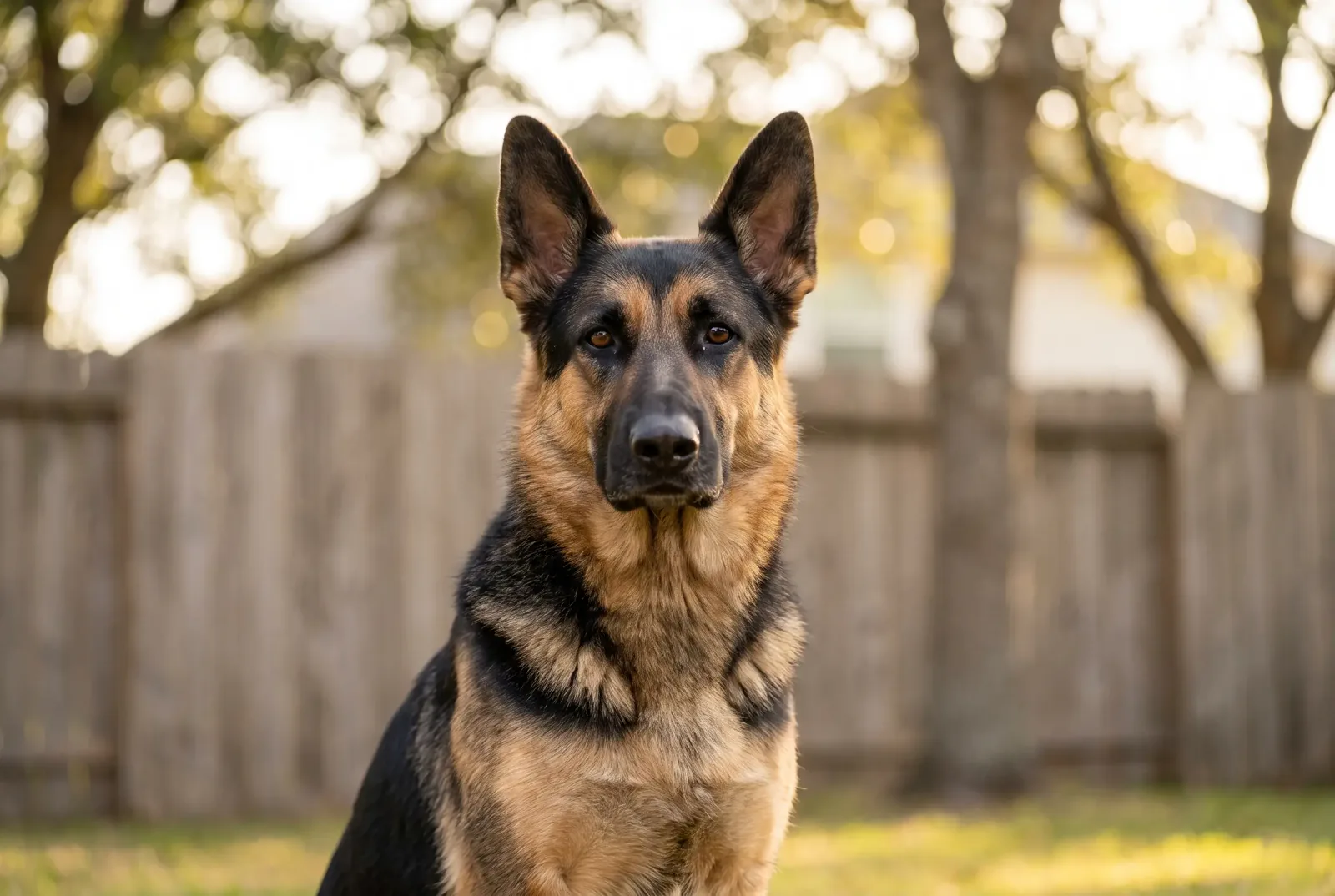
Most of the large breeds I write about here follow the same broad logic: wait for the skeleton, somewhere around a year to eighteen months, and you have done well by the dog. The German Shepherd is the breed that made me move my own recommendation later.
There are two reasons, and the second one is the one almost nobody mentions.
The joint numbers in this breed are stark. Not "slightly elevated" — four times the intact rate in females spayed before six months. When I first read that carefully I went back and re-read it, because it is a bigger jump than most breeds show.
But the finding that actually changed how I counsel German Shepherd families is the incontinence one. In most breeds studied, spay incontinence barely registers. In this breed it did — and it is the kind of problem a family lives with every day for years.
— Dr. P
What the research actually shows
The German Shepherd is one of the 35 breeds in the large UC Davis neutering study, and it also has a dedicated paper of its own from the same group — a rare thing. That means the guidance here rests on breed-specific evidence rather than on reasoning across from other large dogs.
For females, the joint findings were these. About five percent of intact German Shepherd females developed one or more joint disorders — hip dysplasia, elbow dysplasia, or cruciate ligament rupture. Among females spayed before six months, that rose to twenty percent. Among those spayed between six and eleven months, fifteen percent. Both increases were statistically significant.
The incontinence figure deserves its own paragraph, because it is the part that separates this breed from the other large dogs. Roughly nine percent of German Shepherd females spayed from under six months through a year of age went on to develop urinary incontinence, and that increase was statistically significant. Most breeds in that study showed no meaningful signal at all.
What that looks like in practice is a dog who leaks urine in her sleep — wet bedding, damp patches where she has been lying. It is not painful and it is not dangerous, and it usually responds well to a daily medication. But it is generally a lifelong management issue, and it is entirely reasonable to want to reduce the odds of it.
The cancer picture, by contrast, is reassuring. Unlike the Golden Retriever, where early spaying was linked to a genuine rise in several cancers, the German Shepherd showed no appreciable increase in the cancers followed at any spay age. So this is an orthopaedic and urinary conversation, not a cancer one.
One caveat I will give you honestly: these are percentages from a hospital population, and the study's per-breed sample sizes are published separately from the main text. They tell you the direction and rough size of the risk, not your dog's personal odds.
The old way vs. the way I think about it now
Where this comes from. The study's own guideline for this breed is to delay past two years. My usual large-breed recommendation is twelve to eighteen months. I land at eighteen to twenty-four because I think this breed's evidence genuinely justifies going beyond my normal window, while two-plus years asks more of most families than the marginal difference is worth. That last part is my clinical judgement, not a study finding, and I want you to know which is which.
Where I deviate. If her heat cycles are genuinely unmanageable in your household, or she has had a difficult false pregnancy, moving sooner is reasonable and I will not argue. If she is a working or sport dog, I lean toward the later end. And if she has already been spayed young — many were, mine included over the years — this is not a verdict on her. Most early-spayed German Shepherds live long, sound lives; the research simply lets us tilt the odds a little further in our favour from here.
No honest veterinarian can give you an exact date without meeting your dog. What I can offer is a real conversation about her frame, her growth, and your household, and a plan we settle on together.
How I do the surgery
Waiting until eighteen months means she will be a fully grown seventy- or eighty-pound dog on the day of surgery, and that is exactly where the approach starts to matter. A traditional open spay on a dog that size needs a considerably longer incision than the same operation on a six-month-old puppy, with a correspondingly sorer recovery. The laparoscopic spay I perform removes the ovaries through two or three keyhole incisions of about a centimetre and a half under camera guidance, so the incision does not grow with the dog. Most are comfortable and moving normally within two or three days — which for a German Shepherd, a breed that does not take kindly to being told to rest, is worth a great deal.
What the day looks like
She comes in that morning having skipped breakfast, has an IV catheter placed, plus pre-anaesthetic bloodwork if you've chosen it (I recommend it, and it's priced separately), and is monitored continuously while she is under. I do the surgery myself — I have been a solo veterinarian since 1998, so the person who examined her and the person holding the instruments are the same person. She goes home the same day with pain medication, closed with absorbable suture and surgical glue, so there is nothing to remove later.
If you're concerned about bloat, ask me about her individual risk and whether preventive stomach tacking is appropriate. More detail on the day itself is on what to expect from your pet's surgery.
German Shepherd spay questions
Because this breed's numbers are genuinely worse than most, and I would rather tell you that than round it off. In the largest study of its kind, German Shepherd females spayed before six months had joint disorders at four times the rate of intact females. Very few breeds show a jump that steep. Combine that with the incontinence finding and this is the one large breed where I ask families to hold out past the usual year-to-eighteen-months window.
It is urine leaking while she sleeps or rests, caused by reduced tone in the urethral sphincter after her oestrogen drops. In the German Shepherd data it reached about nine percent among females spayed from under six months through a year of age, which was statistically significant — most breeds in that study showed nothing meaningful. It is manageable with daily medication and it is not dangerous, but it is lifelong, and it is a real reason to let her mature first.
Yes, and that is the honest trade-off on the other side. Spaying before the first heat gives the strongest protection against mammary tumours, and that protection falls away with each cycle she goes through. In this breed you are weighing that against an unusually large orthopaedic and incontinence benefit from waiting. For most German Shepherds I think waiting wins that argument, but it is a judgement about your individual dog, not a slogan.
It sharpens the same conclusion. A dog who will be jumping, turning hard, and doing protection or agility work is putting exactly the kind of load on her joints that this research is about. If anything I am more insistent about waiting for skeletal maturity in a working German Shepherd than in a companion one, because the consequences of a cruciate tear or a bad hip land harder on a dog whose life is physical.
Genetics are the biggest factor by far, and no spay timing will override a bad hip pedigree. What the timing appears to influence is the margin: removing her hormones before the growth plates close lets the long bones grow slightly longer than they otherwise would, which changes the joint angles. So think of waiting as protecting the margin you have rather than as preventing dysplasia outright. Good breeding, lean body weight, and sensible exercise still matter more.
Not at all — you have effectively done what I recommend. Spaying an adult German Shepherd is straightforward, and the joint concerns in the research are about spaying very early rather than late. The main things we gain now are eliminating any risk of pyometra, which affected about three percent of intact females in that dataset, and ending the heat cycles.
Keep reading
Every breed grows on its own schedule. If one of these is closer to your dog, start there.
Your German Shepherd, the other half of the question:
Similar-size breeds:
The whole picture: read the veterinarian's breed-by-breed spay and neuter guide, or see how the laparoscopic spay works.
Whether she's a gangly five-month-old or nearly grown, I'm glad to talk it through — and to spay her the gentlest way when the time is right.
Request an Appointment Or text (281) 859-9244