Somewhere between eighteen and twenty-four months, once he has finished building. But I will be honest with you: for a male Dane the timing question is the less interesting half of this appointment. The decision that may actually affect how long he lives is a different one, and it is easy to miss.
Most of these breed guides spend their length arguing about a date, because in most breeds the date is where the risk sits. With a male Great Dane I can deal with the date fairly quickly, and I would rather spend the space on something more useful.
The research looked at male Great Danes and found essentially nothing. No increase in joint disorders at any neuter age. No increase in cancers. Its guidance amounts to: pick whatever age suits you.
Bloat is a serious emergency in Great Danes. I want families to recognize the warning signs and know that preventive options exist, without treating any extra surgery as automatic.
— Dr. P
So this page covers the timing briefly and honestly, and then spends its time on the conversation I think you are more likely to be glad you had.
What the research actually shows
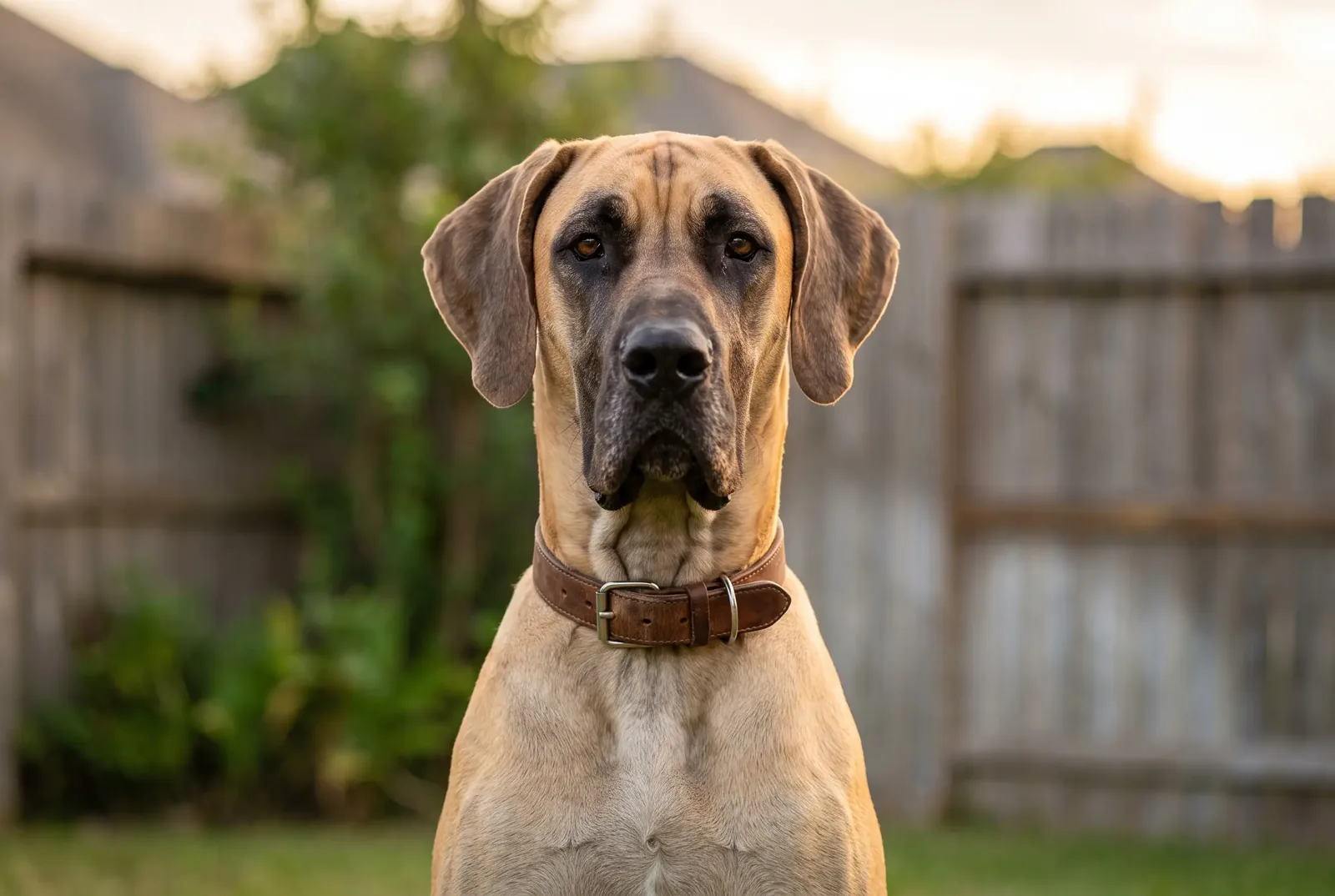
The Great Dane is one of the 35 breeds in the UC Davis neutering study, with 90 intact and 103 neutered males. The findings for males are about as undramatic as findings get: roughly 1% of intact males developed a joint disorder, with no evident increase from neutering at any age, and about 6% developed one of the cancers followed, again with no evident increase. The study's guideline for male Danes is simply that those wishing to neuter should decide on the appropriate age.
As always with a null result, I would rather you knew its limits. Around a hundred neutered males split across four age bands is not a large group, and a study that size can return no cases even when a small real risk exists underneath. So "no evident increase" is genuinely reassuring, but it is not the same as proof of no effect.
Where my eighteen-to-twenty-four months comes from, since the paper plainly does not require it. The study did make a recommendation for female Great Danes, and the reason it gave was not statistical — it pointed to the breed's large body size and its late musculoskeletal development, and suggested considering neutering well beyond a year. That reasoning has nothing to do with sex. A male Dane is the same enormous animal finishing his growth just as late. So I extend the paper's own stated logic across to males, which is an inference on my part rather than a finding about males, and I would rather label it than let it pass as science. The practical case is easy anyway: he has no pyometra risk and no mammary clock, so waiting costs him nothing at all.
That is genuinely the whole of the timing conversation. Now the part I care more about.
Understanding bloat risk
Great Danes sit at the top of almost every list of breeds at risk of gastric dilatation and volvulus — bloat, with a twist. The stomach fills with gas and then rotates on itself, which cuts off its own blood supply and traps everything inside. It comes on fast, usually in a dog who seemed fine an hour before, and without emergency surgery it is generally fatal. In the largest prospective study of the condition, more than a quarter of the dogs who developed it died.
A preventive gastropexy (stomach tacking) can reduce the risk of the stomach twisting, but it does not prevent bloating. Whether to consider it depends on your dog's individual health and risk.
A spay and a neuter are different surgeries. If you're considering stomach tacking for a female Dane, ask about it separately as part of the surgical plan.
A neuter is not abdominal surgery. It uses a small incision in front of the scrotum. For a male, a gastropexy would be a separate abdominal procedure, not part of the neuter.
If you're concerned about bloat, let's talk through his risk and the options. Stomach tacking is a separate decision, with its own risks, cost, and recovery.
If you would like to think it through properly, I have written more about the procedure itself, and about bloat generally, on the Great Dane spay guide — the surgical explanation there applies to a male just as well, even though the bundling does not.
What I recommend
Where I deviate. If he is marking indoors, mounting persistently, escaping the yard, or showing hormonally driven tension with other males, we move sooner — with a dog this size, behavior that makes him difficult to live with is not a small problem, and a Dane who loses his home is in real trouble. If a testicle has not descended by six months it should come out on its own timetable rather than waiting for two years, because an undescended testicle carries a substantially higher cancer risk. And if he was neutered at six months before you got him, nothing here is a verdict on your dog: the study found no penalty for male Danes at any age, so on this breed's own evidence he lost nothing at all.
No honest veterinarian can hand you an exact date without meeting your dog. Bring him in and we will look at how he is growing and talk through his individual risk and options.
What the day looks like
A neuter on its own is a short, straightforward operation — one small incision in front of the scrotum, a fraction of the time an abdominal surgery takes. Any separate abdominal procedure would require its own discussion of risks and recovery beforehand.
He skips breakfast that morning, has an IV catheter placed, plus pre-anaesthetic bloodwork if you've chosen it (I recommend it, and it's priced separately), and is monitored continuously while he is under, with attention to positioning and padding that matters more in a dog this heavy. I do the surgery myself — I have been a solo veterinarian since 1998, so the person who examined him and the person holding the instruments are the same person. He goes home the same day with pain medication. A Dane who feels well still needs his activity genuinely restricted afterward, which with a dog this size is a household logistics problem as much as a medical one. More on the day itself is on what to expect from your pet's surgery.
Great Dane neuter questions
Because I am borrowing the paper's own reasoning from the other half of the breed. For male Danes it found no increase in joint disorders or cancers at any neuter age and left the timing to the owner. But for female Danes it did make a recommendation, and the reason it gave was not a statistical finding at all — it was the breed's large body size and its late musculoskeletal development, which argue for going well beyond a year. That reasoning applies just as well to a male, who is the same size and finishes growing just as late. So I extend it to both sexes. I want to be clear that this is my inference rather than something the study concluded about males, and that waiting costs him essentially nothing either way.
A male neuter does not involve the abdomen, so stomach tacking would be a separate procedure, with its own risks and recovery. If you're concerned about bloat in your Great Dane, ask about his individual risk and whether preventive surgery is appropriate. It is not an automatic part of neutering.
It depends on your dog's risk and health. Stomach tacking can reduce the risk of a dangerous twist, but it does not prevent bloating and is a separate surgery for a male dog. Ask your veterinarian about the benefits, risks, cost, and recovery before deciding.
Learn this properly, because minutes matter. The classic picture is a dog trying repeatedly to vomit and bringing nothing up, or only white froth. He will be restless and unable to settle, pacing, looking round at his flank, sometimes drooling heavily and standing with his elbows out. The belly may look distended and drum-tight behind the ribs, though in a deep-chested Dane it can be surprisingly hard to see from the outside. As it progresses he becomes weak, his gums go pale, and he may collapse. If you see unproductive retching and restlessness in a Great Dane, treat it as an emergency and get him to a vet immediately — do not wait to see whether he settles overnight, because he will not.
It does, and it is worth understanding because it is the mechanism this whole conversation is built on. The sex hormones are part of what signals the growth plates at the ends of the long bones to close. Remove them early and those plates stay open a little longer, so the bones grow slightly longer than they otherwise would. The result is a marginally taller, leggier dog with subtly different joint angles. In a small dog that hardly signifies. In a dog who is already going to be well over a hundred pounds and stand at your waist, I would rather let him build to the proportions he was designed for and then do the surgery.
It requires more planning rather than being inherently more dangerous, and giant breeds are where careful preparation earns its keep. Drug doses do not scale in a straight line with body weight in a dog this large, so they are calculated rather than simply multiplied. Positioning and padding matter more, because a heavy dog can compromise his own circulation and put pressure on nerves if he is laid out carelessly. And Great Danes as a breed have a recognised predisposition to heart muscle disease, so I listen carefully to his heart beforehand and will investigate anything I do not like before we schedule rather than on the day. An IV catheter and continuous monitoring are standard here for every patient, and I recommend pre-anaesthetic bloodwork too (priced separately).
Keep reading
Every breed grows on its own schedule. If one of these is closer to your dog, start there.
Your Great Dane, the other half of the question:
Similar-size breeds:
The whole picture: read the veterinarian's breed-by-breed spay and neuter guide, or see how the laparoscopic spay works.
Bring him in and we'll look at how he's growing. If you're concerned about bloat, we can discuss his individual risk and options.
Request an Appointment Or text (281) 859-9244