Around twelve months for a dog who will finish over about 44 pounds, which covers most of them. There is no breed-specific research here — and the reason why is more interesting than the usual "nobody has studied it".
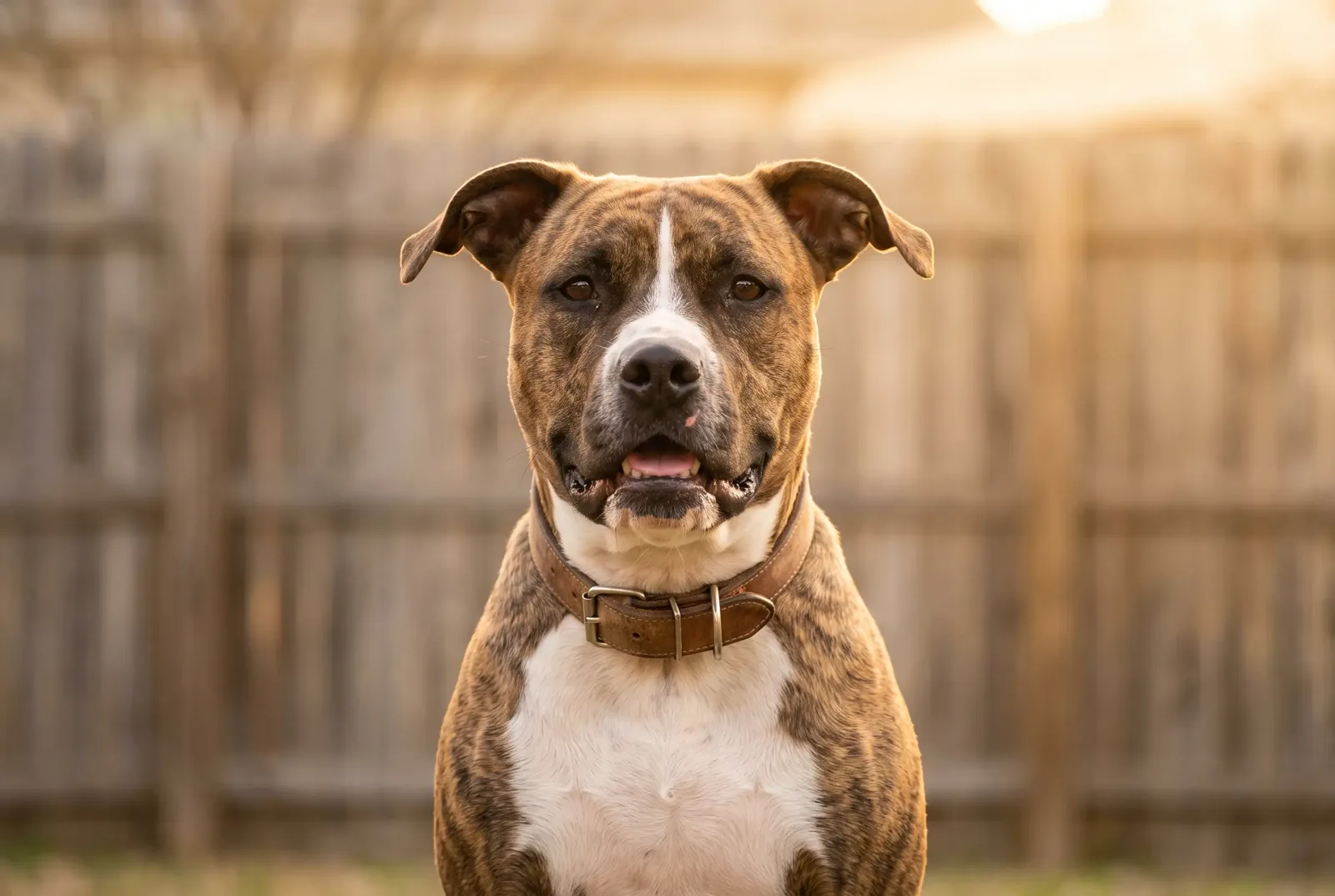
On the doodle pages of this site I tell owners that the breed name does not tell you what size dog you have, so the answer has to be keyed to projected adult weight instead. This page has the same shape of problem, turned one step further.
The big breed-by-breed studies do not include the American Pit Bull Terrier, the American Staffordshire Terrier or the Staffordshire Bull Terrier. That much is straightforward.
But the deeper issue is that "pit bull" is not really a breed. It is a label covering several distinct pedigree breeds and a very large number of mixed dogs, applied mostly on the basis of how a dog looks. So even a study of "pit bulls" would be studying an assortment — and might not describe the dog standing in front of me.
— Dr. P
Which sounds like a dead end and is not. There is research built for exactly this situation, and it happens to be better suited to your dog than a breed study would be.
What the research actually shows
The same UC Davis group that produced the breed-by-breed work published a companion paper that ignores breed entirely. It sorted mixed-breed dogs into five adult weight categories and asked the same questions about joint disorders and cancers. For a dog whose ancestry you cannot be sure of, that is not a fallback — it is genuinely the more applicable evidence, because it keys the answer to something you can actually measure.
The line falls at about 44 pounds. Below it, no joint penalty was found for spaying early. Above it, the risk climbed. Most dogs of this type finish somewhere between 40 and 70 pounds, which puts the majority squarely in that 43-to-64-pound band — the group where females showed roughly three times the intact rate of joint disorders when spayed between six and eleven months.
The cancer picture is the reassuring part. Across every weight category, the study found no significant increase in cancer associated with neutering at any age. Whatever you decide about timing, that is not the thing to lie awake over — which is a genuinely different position from a Golden Retriever owner's.
Being straight about the limits: this is evidence about dogs of her size, not about her ancestry. If she is a well-bred American Staffordshire Terrier from known lines, or if a DNA test has told you what she actually is, that is real information and worth bringing to the conversation. For most dogs wearing this label, weight is the honest basis.
What I recommend
How to work out which she is. If you know her parents, use them. If she came from a shelter with no history, bring her in at four or five months and I will estimate her adult size from her frame, her paws and her growth curve. Dogs of this type are dense and muscular, so they often weigh more than they look — a dog who seems medium-sized can easily finish in the fifties.
What waiting costs her. Mammary protection, mostly. Spaying before the first heat gives the strongest protection and it erodes with each cycle. That is a real price, and the reason I do not simply tell every large dog to wait indefinitely.
Where I deviate. If housing or insurance requirements set a date, tell me what they actually say and we will work inside them — a dog with a secure home is better off than a dog without one, and that is not a compromise I make grudgingly. If her heat cycles are unmanageable in your household, earlier is reasonable. And if she was already spayed at four months in a shelter, which is true of a great many dogs of this type, this page is not a verdict on her — most early-spayed dogs live long, sound lives.
No honest veterinarian can hand you an exact date without meeting your dog. Bring her in and we will settle it together.
How I do the surgery
If you wait until around twelve months she will be a fully grown, densely muscled fifty-plus-pound dog on the day of surgery, and that is where the approach starts to matter. A traditional open spay at that size needs a considerably longer abdominal incision than the same operation on a six-month-old puppy, with a correspondingly sorer recovery. The laparoscopic spay I perform takes the ovaries through two or three keyhole incisions of about a centimetre and a half under camera guidance, so the incision does not scale up with the dog. Most are comfortable and moving normally within two or three days — which matters for a strong, athletic dog who will not understand why she is suddenly being told to take it easy.
What the day looks like
She comes in that morning having skipped breakfast, has an IV catheter placed, plus pre-anaesthetic bloodwork if you've chosen it (I recommend it, and it's priced separately), and is monitored continuously while she is under. I do the surgery myself — I have been a solo veterinarian since 1998, so the person who examined her and the person holding the instruments are the same person. She goes home the same day with pain medication, closed with absorbable suture and surgical glue, so there is nothing to remove later.
One practical note for this body type: these dogs have a lot of muscle and very little give in their skin, and they tend to be enthusiastic about getting back to normal. The restriction afterward is worth taking seriously even when she looks completely fine on day two. More detail on the day itself is on what to expect from your pet's surgery.
Pit bull spay questions
Two reasons, and the second is the more interesting one. The large breed-by-breed study covers 35 pedigree breeds and a 2024 follow-up added five more; none of them is the American Pit Bull Terrier, the American Staffordshire Terrier or the Staffordshire Bull Terrier. But even if such a study existed, there is a deeper problem: pit bull is not really a breed. It is a label applied to several distinct pedigree breeds and to a very large number of mixed dogs, mostly on the basis of how they look. So a study of dogs labelled that way would be studying an assortment rather than a breed, and its findings might not describe your dog at all.
The same research I use for doodles, and for the same reason. The UC Davis group published a companion paper that sorted mixed-breed dogs into five adult weight categories instead of by breed, and asked the same questions about joint disorders and cancers. For a dog whose ancestry you cannot be certain of, that is genuinely the better evidence — it keys the answer to something you can actually measure, which is how big she is going to be. It turns an unanswerable question about her pedigree into an answerable one about her weight.
It puts her in the 43-to-64-pound band, which is where the weight research found a real effect in females. Females in that group spayed between six and eleven months had joint disorders at about 12%, against roughly 4% in intact females — around three times the rate. That is the single number driving my recommendation to wait until about twelve months. If she were going to finish under about 44 pounds the picture would be quite different, because the two smallest weight groups showed no joint penalty at all from early spaying.
Yes, and it is worth weighing rather than glossing over. Spaying before the first heat gives the strongest protection against mammary tumours, and that protection erodes with each cycle she goes through. By twelve months she will very likely have had one. There is also pyometra, a uterine infection of intact females that is genuinely dangerous when it happens, and every cycle is another opportunity for it. In a fifty-pound dog I think the joint argument wins that exchange, but it is a trade rather than a free choice.
It changes what is actually available to you, and that is a legitimate part of the decision rather than something to apologise for. Housing and insurance requirements sometimes specify desexing by a particular age, and a dog with a home is better off than a dog without one. If a requirement means spaying her at seven months, we do that and manage the rest well — keep her lean, keep her conditioned, and stay alert for lameness. Tell me what the requirement actually says, though, because sometimes it specifies that a dog be spayed rather than spayed by a given date, and that is a distinction worth checking before we rush.
If we have waited until twelve months, yes, and this is a body type where it earns its keep. She will be a fully grown, muscular fifty-plus-pound dog on the day, and a traditional open spay at that size means a considerably longer abdominal incision than the same operation on a puppy. The laparoscopic approach takes the ovaries through two or three keyhole incisions of about a centimetre and a half, so the incision does not scale up with the dog. Most are moving normally in two or three days, which matters for a strong, athletic dog who will not understand why she is being asked to rest.
Keep reading
Every breed grows on its own schedule. If one of these is closer to your dog, start there.
Your Pit Bull & American Staffordshire Terrier, the other half of the question:
Similar-size breeds:
The whole picture: read the veterinarian's breed-by-breed spay and neuter guide, or see how the laparoscopic spay works.
Bring her in and we'll estimate her adult size from her frame and her growth curve, then pick the window that fits her and your household.
Request an Appointment Or text (281) 859-9244