Somewhere between twelve and eighteen months, though the research asks nothing of you here and I will say clearly where my judgement goes beyond it. There is a striking number in this breed's data — and the interesting thing about it is that your decision has no effect on it at all.
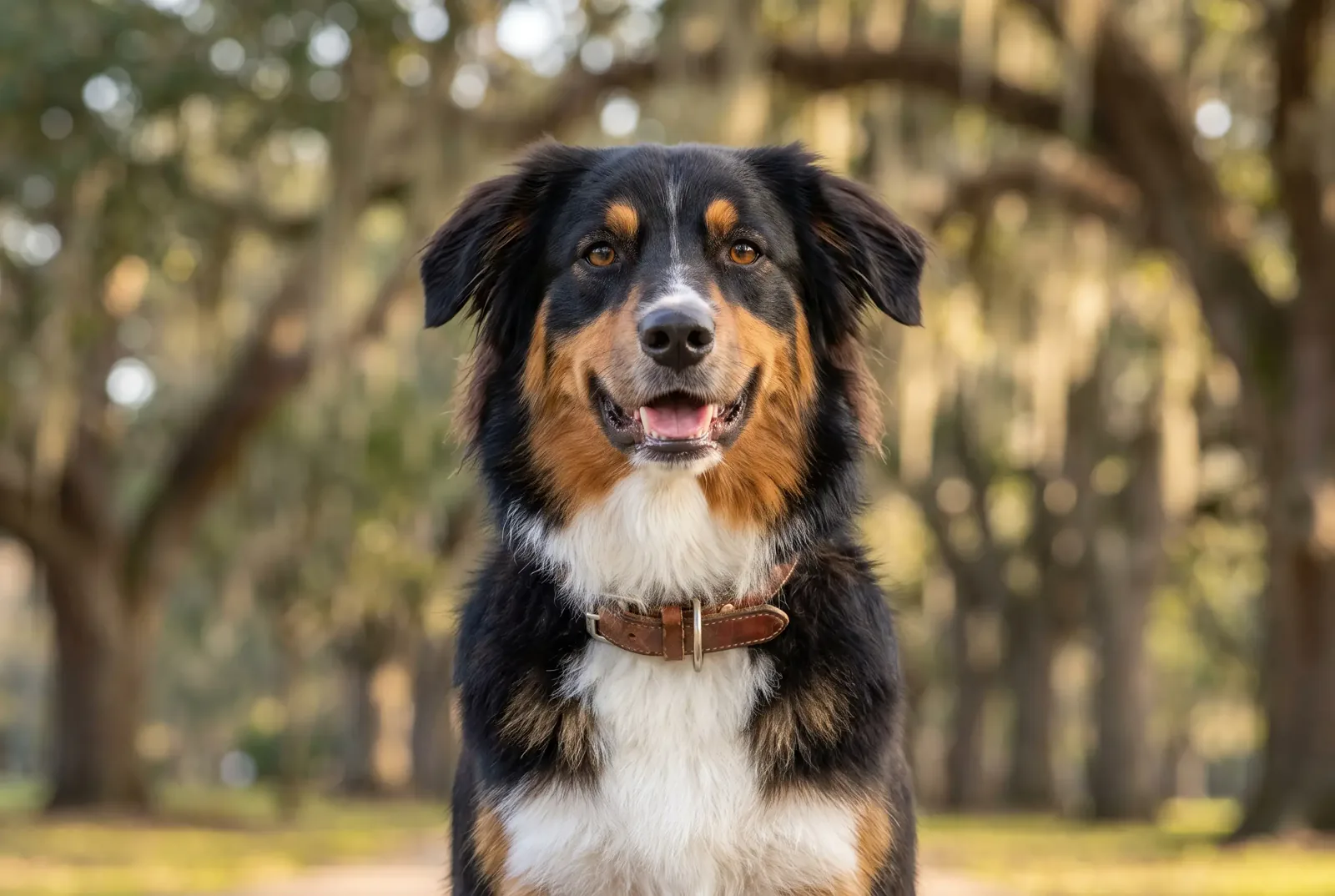
Every page in this series is fundamentally about the same thing: here is a baseline rate of some disease, and here is how neutering at various ages shifts it. That is the shape of the whole field.
The Australian Shepherd data contains the most arresting figure I have come across in it, and neutering has nothing whatever to do with that figure.
Among intact Australian Shepherds, about 9% of males developed one of the cancers followed. Among intact females, about 1%. Roughly a ninefold difference between the sexes of the same breed.
Those are the rates in dogs who were never neutered at all. Whatever is behind it, no surgery date you choose will move it. The paper reports it without explanation, and I am not going to invent one.
— Dr. P
I lead with it because it puts the rest of this page in proportion. The biggest number here is not the one you came to ask about, and the one you came to ask about turns out to be fairly small.
What the research actually shows
The Australian Shepherd is one of the 35 breeds in the UC Davis neutering study, with 93 intact and 135 neutered males. Joint disorders affected about 3% of intact males, with no evident increase from neutering at any age — a reassuring result for a dog of this size and athleticism. Cancers ran at about 9% in intact males, with no overall increase associated with neutering. The study's guidance for males is simply that those wishing to neuter should decide on the appropriate age.
Where I differ from the paper. It asks nothing of you; I suggest twelve to eighteen months. That gap is mine and I would rather label it than let it read as evidence. The reasoning is ordinary: his growth plates finish closing around a year, the mechanism people worry about in big dogs does not care that this breed's numbers came back quiet, and waiting costs a male dog essentially nothing — no pyometra risk, no mammary clock. Given a free option and a plausible mechanism, I take the option. If you have a reason to do it at eight months, the evidence is on your side rather than mine. I make the same disclosure on the Labrador page and the Husky page, for the same reason.
On the female side it runs slightly differently — there the researchers found a cancer trend they could not confirm and chose to flag it. That is on when to spay an Australian Shepherd.
The thing on this page that genuinely matters
If the neuter date is one of the less consequential decisions about a male Aussie's health, this is one of the most, and it takes a cheek swab.
Herding breeds can carry a mutation in a gene called MDR1, also written ABCB1, which normally produces a protein that pumps certain drugs back out of the brain before they accumulate. In a dog with two copies of the mutation, drugs that are entirely safe in other dogs at ordinary doses can build up in the nervous system and cause severe effects. The families involved include some sedatives and pre-anaesthetic medications, some anti-diarrhoeals, and the ivermectin-class parasite treatments — several of which come up naturally around a surgical visit.
Because an affected dog looks completely normal until the day he receives one of those drugs, and because a neuter is very often the first anaesthetic of his life. This is the appointment where not knowing has consequences.
Being affected does not mean he cannot be anaesthetised — it means his drugs are chosen deliberately, and many remain usable at adjusted doses with proper monitoring. What causes harm is a standard dose given to a dog nobody tested.
The test is done once and the answer holds for life. It applies across the herding group, not just Aussies — Border Collies, collies of various kinds, Shetland Sheepdogs and mixes with any of them behind. I go through it in full on the female page.
What I recommend
Where behaviour overrides it. If he starts marking indoors, mounting persistently, escaping to find a female, or showing hormonally driven tension with other males, bring him in and we will move sooner. What neutering will not touch is the herding, the heel-nipping, the ball obsession or the inability to settle — that is several hundred years of selective breeding, not testosterone, and surgery is the wrong tool for it entirely.
And the one thing that changes the plan: a testicle that has not descended by six months. It carries a substantially higher risk of becoming cancerous and cannot be monitored by feel, so it comes out on its own timetable rather than waiting for a birthday.
No honest veterinarian can hand you an exact date without meeting your dog. Bring him in and we will settle it together.
What the day looks like
A neuter is the shorter and simpler of the two surgeries — the testicles are external, so it is one small incision just in front of the scrotum. That is also why I do not offer a laparoscopic version, unlike a laparoscopic spay where the alternative is a long abdominal incision. He skips breakfast, has an IV catheter placed, plus pre-anaesthetic bloodwork if you've chosen it (I recommend it, and it's priced separately), and is monitored continuously. If his MDR1 status is known, his drug plan is built around it; if not, tell me he is a herding breed and I will plan conservatively. I do the surgery myself; I have been a solo veterinarian since 1998.
The genuine challenge is the two weeks afterward, and it needs a plan made in advance. Tire his brain instead of his body: scentwork, puzzle feeders instead of a bowl, stationary trick training. Short calm lead walks only — no ball, no frisbee, no free running, no stairs, no jumping on or off furniture. An under-occupied Aussie invents his own entertainment, and it is always the thing I asked you to avoid. More on the day itself is on what to expect from your pet's surgery.
Australian Shepherd neuter questions
The paper reports it and does not explain it, and I am not going to invent an explanation to fill the gap. It is a striking difference — roughly ninefold between the sexes of the same breed — and what makes it interesting for our purposes is that it has nothing to do with neutering at all. Those are the rates in dogs who were never neutered. Whatever is behind it, choosing a surgery date does not touch it. I mention it because it puts the timing question in proportion: the largest number on this page is one your decision has no effect on.
Less than for most breeds I write about, and I would rather be honest about that than manufacture importance. The study found joint disorders in about 3% of intact Aussie males with no evident increase from neutering at any age, and no overall cancer increase either. Its guidance is that you should pick whatever age suits you. My twelve-to-eighteen-month suggestion is me taking a free option because his growth plates finish around a year and waiting costs a male dog essentially nothing — not because the evidence demands it.
Yes, and the fact that he seems healthy is exactly the point — an affected dog looks completely normal right up until he receives one of the drugs involved. It is a single cheek swab, done once, and the answer holds for life. The families of drugs concerned include some sedatives and pre-anaesthetic medications, some anti-diarrhoeals and the ivermectin-class parasite treatments, several of which naturally come up around a surgical visit. I go through it properly on the female page; every word applies to him.
Not in the way you are hoping, and with a herding breed the disappointment is predictable enough that I would rather head it off. Neutering reduces roaming to find a female, urine marking, persistent mounting and some male-to-male tension. It does nothing for herding the children, nipping at heels, obsessive ball fixation, barking at movement or an inability to switch off. Those traits are the breed doing exactly what it was built to do, and no surgery edits them out. What helps is work, structure and genuinely enforced rest — an Aussie who never learns to switch off does not become calmer with age, he becomes more wound up.
The data says no, and in this breed that is a fairly comfortable answer to give. Joint disorders showed no evident increase at any neuter age, including the earliest band, and there was no overall cancer increase either. So there is nothing to undo and nothing to feel bad about. Keep him lean, keep him properly exercised and mentally worked, get his MDR1 status on record if it is not already, and let me look him over once a year.
By tiring his brain rather than his body, and by planning it before the day. Scentwork is the most useful tool there is — scattering food around a room or hiding it under cups is genuinely tiring and involves no running. Feed him out of puzzle toys rather than a bowl. Stationary trick training, like chin rests and nose targets, gives him something to succeed at without movement. Short calm lead walks only, and no ball, no frisbee, no free running, no stairs and no jumping on or off furniture. An under-occupied Aussie will invent his own entertainment, and it will be precisely the activity I asked you to avoid.
Keep reading
Every breed grows on its own schedule. If one of these is closer to your dog, start there.
Your Australian Shepherd, the other half of the question:
Similar-size breeds:
The whole picture: read the veterinarian's breed-by-breed spay and neuter guide, or see how the laparoscopic spay works.
The date is genuinely flexible in this breed. The MDR1 test is the part I'd rather you didn't leave until the day it matters.
Request an Appointment Or text (281) 859-9244