
Laparoscopic vs Traditional Spay: What Houston Dog Owners Should Know
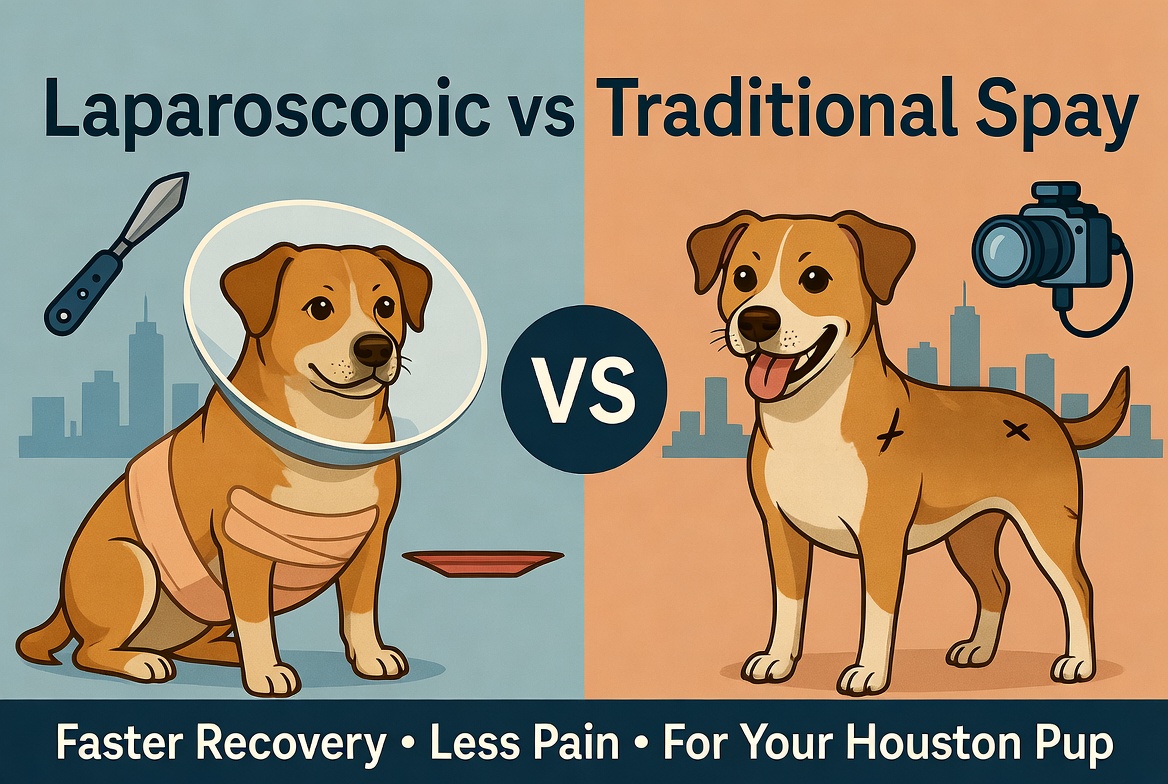
Laparoscopic vs traditional spay: what Houston dog owners should know
Here's the short version. If your dog needs to be spayed, there are now two ways to do it. The traditional way has been the standard for decades. The laparoscopic way uses a few tiny incisions instead of one large one. The dog recovers faster, hurts less, and the risk of complications drops. It costs more.
That's the whole story. The rest of this explains why.
What actually happens in each surgery
A traditional spay, the version most clinics still do, involves a 3 to 4 inch incision down the middle of the belly. Your vet reaches in, finds the ovaries and uterus, clamps the blood vessels by feel, cuts everything free, and removes it. The whole reproductive tract comes out. The incision gets stitched closed in layers. Total surgery time runs roughly 45 to 60 minutes for an average dog.
A laparoscopic spay is the same procedure most adults have heard of when a friend gets their gallbladder out. Three small incisions, each smaller than a pencil eraser. A camera goes through one. Tiny instruments go through the others. Your vet sees the inside of the abdomen on a high-definition screen, finds the ovaries, seals the blood vessels with a tool that uses heat, no blind clamping, no guesswork, and removes them. In most cases only the ovaries come out, not the uterus. The incisions are so small they often only need one or two stitches each.
Same outcome. Dog can't get pregnant. Heat cycles stop. Mammary cancer risk drops dramatically if done before the second heat.
Different journey to get there.
Why the difference matters
Think about the last time you knew someone who had abdominal surgery. The person who had laparoscopic gallbladder removal was probably back on their feet in a few days. The person who had the same procedure done the old open way was off work for weeks. Same organ. Same goal. Different recovery because the body has to heal a different amount of tissue.
Dogs are the same. With a traditional spay:
- 10 to 14 days of strict crate rest
- Notable post-op pain, often 5 to 7 days of pain meds
- Higher risk of seroma (a fluid pocket under the incision)
- Higher risk of internal bleeding, because the blood vessels are clamped by feel
- E-collar required to keep the dog from licking the incision open
- More noticeable scar
With a laparoscopic spay:
- 3 to 5 days of restricted activity
- Most dogs are back to normal energy within 48 hours
- Published research shows significantly less post-op pain
- Blood vessels are sealed under direct visualization, so bleeding risk is much lower
- The smaller incisions are easier to keep clean and harder for the dog to mess with
- Scars are tiny and fade within months
One more thing worth knowing. Large or deep-chested breeds (Great Danes, Standard Poodles, German Shepherds, Boxers, Weimaraners) can have a stomach-tacking procedure called gastropexy done at the same time, through the same small incisions. Gastropexy is the single best prevention against bloat (GDV), which kills thousands of dogs every year and is essentially a death sentence if not caught in the first few hours. Doing it through laparoscopy at the time of spay means your dog has one anesthesia, one recovery, and lifelong bloat protection.
Why almost no clinic offers it
Two reasons. The equipment is expensive, often $30,000 to $80,000 for the tower and instruments. And the surgeon needs additional training. Most general practice vets were never taught laparoscopy in vet school. Most still aren't.
If you call around Houston, you'll find a handful of practices that offer it. The rest will tell you the traditional spay is "just as good." It's not dishonest. It's just the procedure they can perform. A surgeon recommends what they can do.
What it costs and why
A traditional spay in the Houston area typically runs $300 to $600 for a small dog and $500 to $900 for a large breed. A low-cost spay clinic might do it for $100 to $200.
A laparoscopic spay typically runs $800 to $1,800 depending on dog size and whether gastropexy is added. The price reflects the equipment, the disposable surgical seals (single-use, sterile), the additional training, and the fact that you're getting a surgery with measurably better outcomes.
If budget is the constraint, a traditional spay is fine. Generations of dogs have done well with it. If you can afford the difference, the laparoscopic version is the better procedure. Same way a robotic prostatectomy is the better procedure than open surgery if you can get to a surgeon who does enough of them.
Who it's right for
Laparoscopic spay makes the most sense for:
- Large or deep-chested breeds, so you can combine it with gastropexy
- Working dogs, hunting dogs, agility dogs (faster return to performance)
- Active families who can't realistically enforce two weeks of crate rest
- Dogs over 50 pounds, where the recovery difference is most dramatic
- Owners who value minimizing pain and risk above cost
Traditional spay is reasonable for:
- Small dogs where the incision is already short
- Budget-constrained households where the lower cost gets the surgery done that would otherwise be delayed
- Older dogs whose reproductive tract has complications, where the open approach is sometimes safer
What to ask your vet
Three questions, plain English:
- How many laparoscopic spays have you personally performed?
- Do you use a vessel-sealing device, or clips?
- Can you do gastropexy at the same time, through the same incisions?
A vet who does these regularly will answer all three quickly. A vet who's done a handful will hedge. A vet who's never done one will probably try to talk you out of it. That's information.
If this were my dog
I would do the laparoscopic version, every time, if I could afford the difference. For a large breed I'd add gastropexy without thinking twice. The math on bloat alone makes it worth it.
For small dogs under 25 pounds, the traditional spay is reasonable and the recovery difference is smaller. For most other dogs, the laparoscopic version is the better procedure and the data backs that up.
If you have questions about whether it's right for your dog, you can book a consult at the clinic or send us a message. We do these every week and can usually tell you in five minutes whether it's the right call for your specific dog.
Dr. P
Hearthstone Animal Clinic
Have a question about your pet?
Dr. Pelton and the Hearthstone team are here to help, the same day when it counts.
Get Your Pet Seen