
Heartworm Disease in Cats: Why Indoor Cats in Cypress Are at Risk
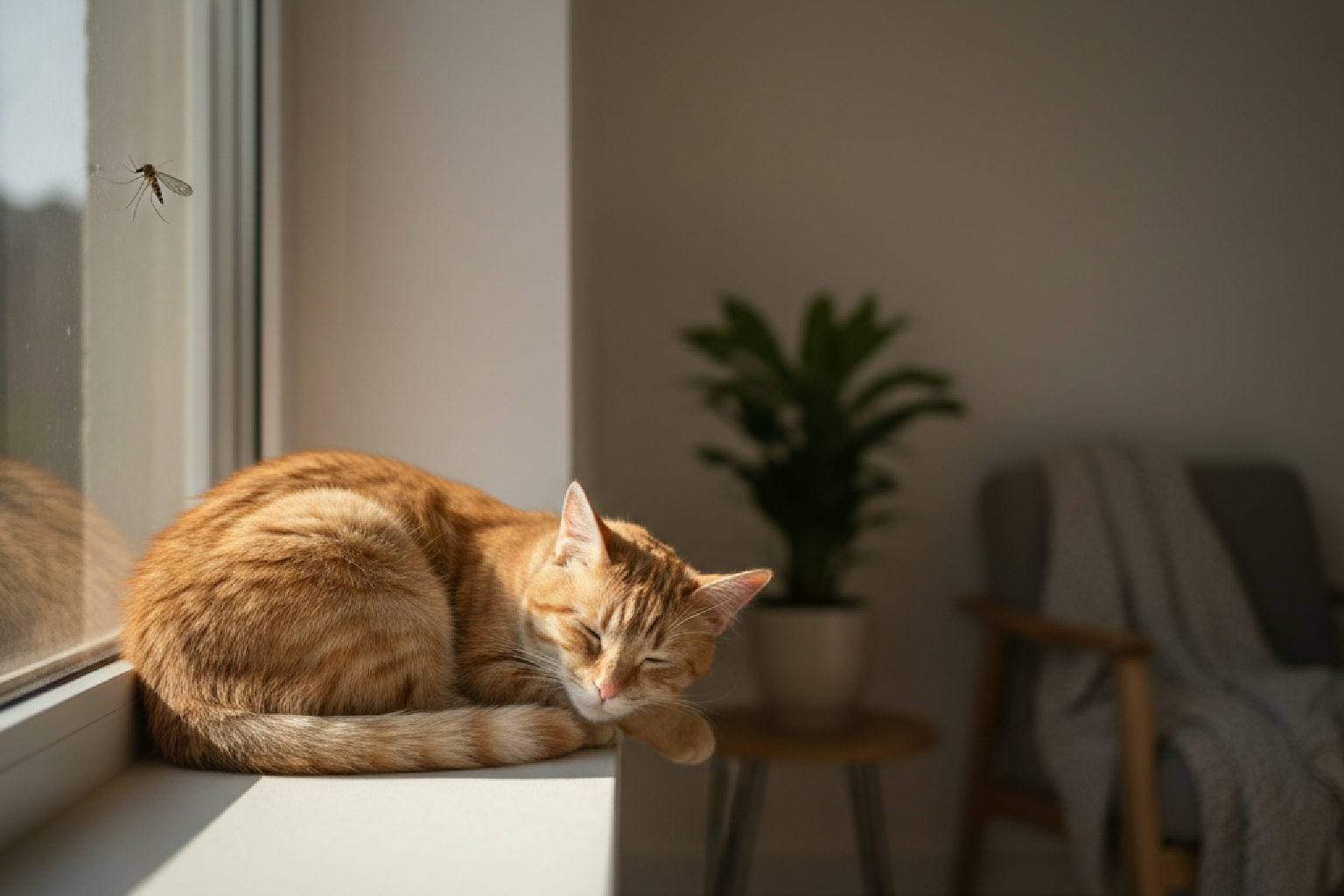
Most cat owners I talk to assume heartworm is a dog problem. It's not. Cats get heartworm too, and in Cypress, TX, where mosquitoes are active nearly year-round, even strictly indoor cats are at real risk. Here's what I tell my clients at Hearthstone Animal Clinic about feline heartworm disease: it only takes one infected mosquito, and that mosquito doesn't need your permission to come inside.
Can indoor cats really get heartworm disease?
Yes. This surprises a lot of people, so let me explain the mechanism. Heartworm is transmitted by mosquitoes. When an infected mosquito bites your cat, it deposits microscopic heartworm larvae into the skin. Those larvae migrate through the body over the next several months, eventually reaching the heart and pulmonary arteries.
The problem is that mosquitoes get into houses. They slip through doors, ride in on clothing, and find gaps around windows. A study published in the Journal of the American Veterinary Medical Association found that 27% of cats diagnosed with heartworm disease were described by their owners as strictly indoor cats. In a humid, subtropical climate like ours here in the Houston area, mosquito exposure is essentially unavoidable.
Texas consistently ranks as one of the top states for heartworm disease in both dogs and cats. The American Heartworm Society classifies our region as high-incidence, meaning the parasite is actively circulating in the local mosquito population.
How is heartworm different in cats than in dogs?
Cats are not natural hosts for heartworm. Dogs are. This distinction matters because it changes how the disease behaves.
Fewer worms, bigger problems
In dogs, heartworm infections often involve dozens of adult worms. In cats, the typical infection is just one to three worms, and sometimes the larvae die before reaching adulthood. But here's the catch: even immature worms cause serious damage in cats. The inflammatory response to dying larvae can trigger a condition called Heartworm Associated Respiratory Disease (HARD), which looks a lot like asthma.
No approved treatment for cats
The drug we use to kill adult heartworms in dogs (melarsomine) is not safe for cats. There is no FDA-approved treatment to eliminate adult heartworms in felines. That leaves us with two options: manage symptoms and wait for the worms to die naturally (which takes two to three years), or pursue surgical extraction in severe cases. Neither is ideal. This is why prevention is the only real answer for cats.
What are the signs of heartworm in cats?
Feline heartworm disease is frustrating to diagnose because the symptoms mimic other conditions. Many cats show vague, intermittent signs that come and go. Some show no signs at all until sudden collapse or death.
Watch for:
- Coughing or wheezing (often mistaken for asthma or hairballs)
- Rapid or labored breathing
- Vomiting (not related to hairballs or food)
- Lethargy or decreased activity
- Weight loss or poor appetite
- Sudden collapse or difficulty walking
The respiratory signs are most common. If your cat has episodes of coughing or labored breathing, heartworm should be on the list of possibilities, especially if they're not on prevention.
How do you test cats for heartworm?
Testing cats for heartworm is more complicated than testing dogs. In dogs, we run a simple antigen test that detects proteins from adult female worms. In cats, that same test often comes back negative even when heartworms are present, because the worm burden is so low and many infections are male-only or immature.
For cats, I typically recommend both an antigen test and an antibody test. The antibody test tells us if the cat's immune system has been exposed to heartworm larvae. A positive antibody test with a negative antigen test suggests exposure, possibly with immature or all-male worms. We may also use chest X-rays or echocardiography to look for characteristic changes in the heart and lungs.
The bottom line: a negative test doesn't completely rule out heartworm in cats, and a positive test doesn't always mean active infection. It requires clinical judgment.
What heartworm prevention works for cats?
Prevention is straightforward, affordable, and far easier than dealing with the disease. At Hearthstone Animal Clinic, I recommend and carry Revolution or Imoxi (formerly Advantage Multi) for cats. Both are topical products applied monthly to the skin between the shoulder blades.
Revolution (selamectin)
- Prevents heartworm disease
- Kills adult fleas and prevents flea eggs from hatching
- Treats and controls ear mites, roundworms, and hookworms
- Safe for kittens as young as 8 weeks
Imoxi (imidacloprid + moxidectin)
- Prevents heartworm disease
- Kills adult fleas
- Treats and controls ear mites, roundworms, hookworms, and intestinal parasites
- Safe for cats 9 weeks and older, weighing at least 2 pounds
Cost for either product runs roughly $15 to $25 per month depending on your cat's weight. That's a small price compared to the diagnostic workup, supportive care, and potential loss if your cat contracts heartworm disease.
Year-round prevention is what I recommend for all cats in Cypress. Our mosquito season doesn't really have an off-season, and missing even one or two months creates a window of vulnerability. If this was my cat, I'd keep them on prevention every month, no exceptions.
Why do so many cat owners skip heartworm prevention?
The instinct makes sense: if your cat never goes outside, it feels unnecessary. And unlike dogs, cats don't have the same visible risk factors. They're not romping through the backyard at dusk when mosquitoes are most active. So the threat feels abstract.
But the data doesn't support skipping it. Indoor cats get heartworm. The preventive care we offer exists because we've seen what happens when cats go unprotected. Heartworm in cats is a disease where prevention costs a few hundred dollars a year, and treatment (when it's even possible) costs thousands with no guarantee of success.
When should you talk to your veterinarian?
If your cat isn't currently on heartworm prevention, that conversation should happen at your next visit. There's no need to wait for symptoms.
If your cat is showing any respiratory signs (coughing, wheezing, labored breathing), schedule an exam sooner rather than later. These symptoms warrant investigation whether the cause turns out to be heartworm, asthma, or something else entirely. Cats hide illness well, so by the time you notice something is off, it's usually been going on for a while.
For senior cats or cats with other health conditions, routine bloodwork can help us get a baseline and catch problems early. Heartworm testing can be part of that workup.
Protecting your cat starts with one conversation
Heartworm disease in cats is preventable. That's the good news. The bad news is that once a cat is infected, our options are limited and the outcome is uncertain. In a place like Cypress, TX, where mosquitoes are a fact of life, keeping your cat on monthly prevention is the single most effective thing you can do.
If your cat isn't on heartworm prevention, or if you've noticed coughing, breathing changes, or unexplained lethargy, let's get them checked out. You can schedule a visit at Hearthstone Animal Clinic or reach us at (281) 859-9244. We'll talk through what makes sense for your cat, whether that's starting prevention, running diagnostics, or both. Don't wait for the one mosquito that gets through.
Have a question about your pet?
Dr. Pelton and the Hearthstone team are here to help, the same day when it counts.
Get Your Pet Seen